In 2026 being a freelancer means not only talent but speed, efficiency, and intelligent systems. Being a freelancer, you are supposed to work high quality always and cope with strict time frames, contact with clients, repeats, and endless administration. It becomes overwhelming in a very short time particularly when there are several clients requiring updates simultaneously.
Here AI entirely transforms the game.
The new generation of artificial intelligence through generative artificial intelligence has provided potent opportunities to freelancers. AI tools are presently assisted in almost every aspect of your workflow of content creation and design to coding, automation, research, outreach, and project management. Rather than get lost in repetitions, you can automate repetitions. You do not need to hurry and make some errors; just work, but faster, and better.
Being a creative professional, developer, consultant, or business-oriented freelancer, the appropriate AI tools can help one complete the project faster, minimize the mistakes, and even accept more commission without getting exhausted. Efficiency is no longer a choice to make, but the most important element that would boost your income and competitive edge in the current market crowded with competitors.
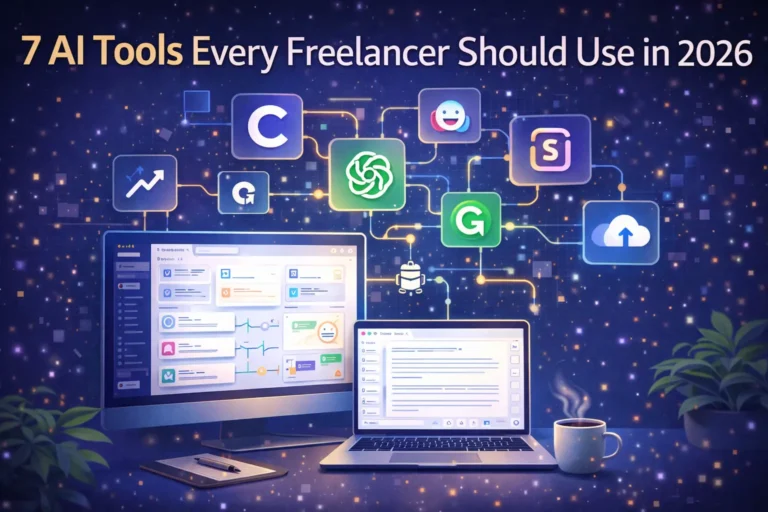
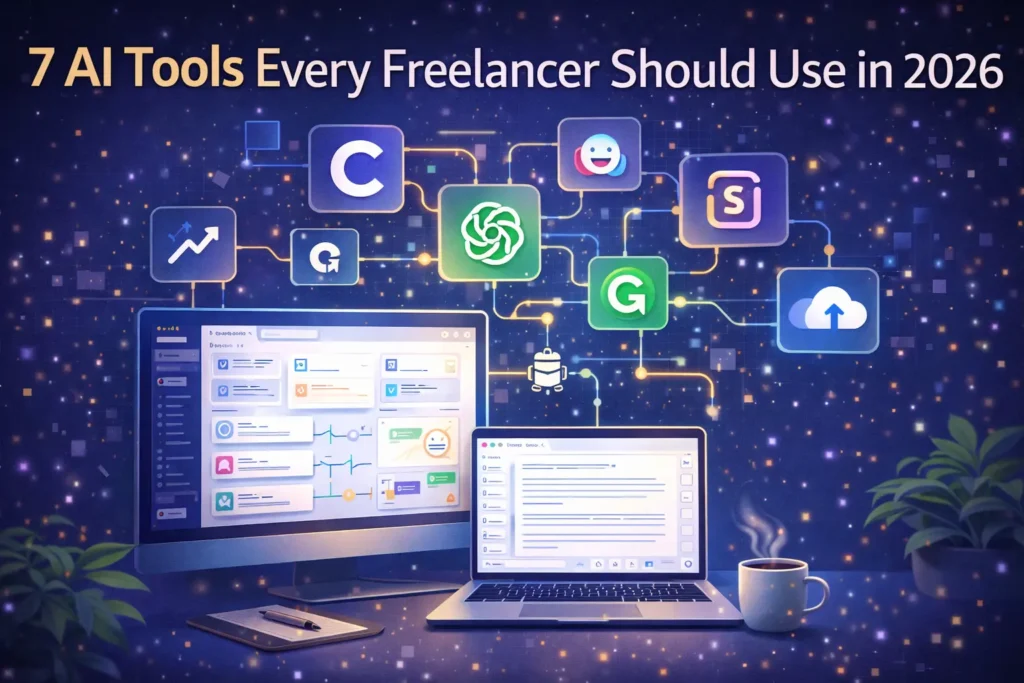
There are the best AI tools in 2026, which you will find in this guide as a freelancer. All the tools have a detailed description of what they are, their main characteristics, and the way in which they are utilized by the freelancers in practice. You will be able to understand what tools exactly fit your workflow by the end of it and how to create an AI-powered system that will help to increase your productivity and profits.
Why Should Freelancers Even Care About AI?
Why Should Freelancers Even Care About AI?
Before we start the list, there’s one question almost every freelancer thinks about:
“Will AI replace freelancers?” The short and simple answer? No.
But here’s the important part: freelancers who use AI will replace those who don’t.
Don’t think of AI as your competitor. Think of it as your free intern — one who never gets tired, never complains, and never asks for tea breaks.It takes care of the boring and repetitive tasks, so you can focus on the things that actually make money — like being creative, building smart strategies, and forming strong relationships with clients.
The truth is, the right AI tools make a freelancer’s work much easier.
- Speed: Tasks that used to take 3 hours can now be done in 30 minutes. First drafts, research, image editing — everything becomes much faster.
- Quality: You can make little mistakes when you are working late at night. Grammars, design recommendations, and even code bugs, which weary eyes might not detect, can be detected by an AI, particularly at 2 a.m.
- Scalability: With AI, you can handle 5 clients instead of 3 — without burning out. More clients, more income, and still keeping your peace of mind.
Now that we understand AI is not a threat but a support system,
let’s move on to the tools.
1. ChatGPT — Your All-Purpose Swiss Army Knife
What It Does
The ChatGPT would be that friend who somehow knows a little about everything had he or she been a person. Need a blog outline? Done. Want help drafting a cold email? Easy. Trying to explain blockchain to a client who thinks it’s a Minecraft thing? ChatGPT’s got you.
OpenAI’s flagship chatbot remains the most versatile AI assistant out there for freelancers. It handles writing, brainstorming, research, coding help, data analysis, and even image generation — all inside one conversation window.
How Freelancers Actually Use It
I have a friend who is a freelance copywriter and she utilizes ChatGPT to create first drafts of product descriptions. She composes 40 products on a weekly basis with an online store brand. Before ChatGPT, that workload was soul-crushing. Now she generates rough drafts in minutes, then spends her time polishing the tone and adding personality. Her output tripled. Her client is thrilled.
Another friend — a web developer — uses it to debug code and explain error messages in plain English. Instead of spending forty-five minutes on Stack Overflow rabbit holes, he gets answers in seconds.
What Makes It Worth It
The free version is surprisingly capable for casual use, but the paid plan (which gives you access to the latest models, image generation, and web browsing) is where the real magic happens. At $20/month, it’s probably the best ROI of any tool on this list.
Pro tip: Set up Custom Instructions with your writing style, preferred tone, and the type of clients you serve. This turns ChatGPT from a generic assistant into your personalized assistant.
2. Grammarly — Because Typos Kill Credibility
What It Does
Let’s be real for a second.
You could write the most impressive proposal of your career… but one small typo in the first paragraph and suddenly the client starts questioning your professionalism.That’s where Grammarly comes in.
It is essentially your under-the-hood editor that assures grammar, spelling, punctuation, clarity of the sentence, tone and the flow in general, on the fly. You can be typing an email, writing a proposal, or a blog post or responding to a client in LinkedIn and it silently works in the background taking care of the fact that everything sounds professional.
And it is not only about correcting commas. It makes the reading easier, highlights clumsy phrases, eliminates superfluous words, and even proposes a more appropriate vocabulary where it is required.
How Freelancers Actually Use It
This isn’t just for writers. Every freelancer writes emails. Send proposals. Negotiates revisions. Follow up on payments. Updates clients. And each and every one of those messages is your personal brand.
Grammarly ensures that you do not make embarrassing errors. Trust me — even one typo in the wrong place can cost credibility. It catches small errors instantly, including the kind your tired brain misses late at night.
One of the most useful features? The tone detector. Suppose a client has not paid you in a course of three weeks and you are writing a follow up message. You would prefer not to sound rude, but confident. Professional — not passive. Grammarly helps you adjust that balance. It tells you how your message sounds and suggests ways to refine it.
For content writers, the plagiarism checker is also a big plus. It scans billions of web pages to make sure your content is original before you submit it.
What Makes It Worth It
The free version covers basic grammar and spelling — and honestly, that alone is helpful.
However, the Premium plan (estimated at approximately $12/month when billed annually) opens:
- Tone detection
- Clarity and readability improvements
- Full-sentence rewrites
- Plagiarism checking
If you send client-facing content — and you do — this tool can easily pay for itself by preventing just one costly mistake.
It’s not a complete writing system on its own. But think of it as your personal editor who works 24/7 and never complains.
For freelancers who want to look sharp, professional, and reliable every single time — it’s a no-brainer.
3. Canva AI — Design Without the Design Degree
What It Does
Not every freelancer is a graphic designer. But every freelancer needs visuals at some point — social media graphics, client presentations, pitch decks, thumbnails, infographics.It is in that case Canva AI capabilities come in and effectively say, “Get out, I have this covered.
The Magic Design tool of Canva creates entire layouts based on a text prompt. All you need to do is describe what you want, choose a style and in a few seconds, you have an amazing-looking design that is professional.
How Freelancers Actually Use It
A social media manager friend of mine produces content for four different brands. She used to spend an hour per brand creating daily graphics. Now, with Canva AI, she generates template variations in minutes, tweaks the colors and copy, and moves on. What used to take half her day now takes about ninety minutes total.
Canva AI is a savior to freelancers who have to create client proposal and pitch decks. You do not have to struggle with PowerPoint anymore and ask a designer friend to assist you. Just describe your deck’s purpose, upload your brand colors, and let the AI handle the heavy lifting.
What Makes It Worth It
Here’s the best part — Magic Design and Magic Write are available on the free plan. The Pro plan ($13/month) gives you access to premium templates, background remover, brand kits, and a massive media library. For any freelancer doing visual work, this is an absurdly good deal.
4. Notion AI — Your Second Brain (That Actually Remembers Things)
What It Does
And, in case you are living a Google Docs life, and random spreadsheet, sticky note, WhatsApp chat and I’ll organize it later life, Well, Notion AI may actually seem like therapy.
Notion is a powerful workspace that can be used to manage notes, projects, databases, and content already. However, with the AI layer on top it is another thing altogether. It is capable of summarizing the meeting notes, it can turn the unarranged brain dumps into an organized outline, you can create the blog posts, you can create your task lists out of the disorganized ideas and it can even make you ask yourself questions about your own writing like it was your personal assistant.
The best part? Everything happens inside the same workspace.
Notion AI makes you faster whether you are doing self-planning, content management, blog pipeline management (Idea → Draft → Edit → Publish) or any other content-related work since the planning and writing processes take place in the same workspace.
It doesn’t complicate your workflow. It simplifies it.
How It Helps Freelancers in Daily Work
Another super practical use? Turning chaos into clarity.
You dump all your random thoughts about a project into a page — half sentences, bullet points, messy ideas. Then you ask Notion AI to organize it. It instantly creates proper headings, structured sections, and clear next steps. It’s like having an editor for your brain.
For bloggers, it’s even better. You can:
- Generate summaries from research or long articles
- Turn scattered notes into a proper blog outline
- Brainstorm titles, hooks, FAQs, and content angles
- Create reusable blog templates
- Auto-fill tags, categories, and status fields in your content database
Personally, one of the biggest upgrades is not living the “files everywhere” life anymore. Everything stays organized inside one clean system. You can even add multiple tags to posts — content type, tone, category, priority — and keep your workflow structured without feeling overwhelmed.
It doesn’t just help you write faster.
It helps you think clearer and stay organized — which, honestly, is half the freelance battle.
What Makes It Worth It
Notion AI costs around $10/month added to any Notion plan (even the free one). If you’re already a Notion user, this is a no-brainer upgrade. If you’re not a Notion user yet, well — this might be the excuse you need to finally try it.
5. Descript — Video and Audio Editing for People Who Hate Video Editing
What It Does
Let me be honest with you for a moment.
Most freelancers think video editing is hard, technical, and honestly… intimidating. Schedules, strata, waveforms – I think you need a degree in film before you can cut a clip. And that is precisely the reason why Descript seems a breath of fresh air.
Descript totally reverses the editing process.
Rather than making edits to video and audio in the classic sense of the terms, Descript transcribes your recording and then offers it in a written form. It converts your audio or video into text in a few minutes automatically. The content can be edited there by editing the text, as in a Word document. Erase a sentence in the transcript and the sentence is erased in the video or audio. Simple as that.
Repeat the word um, uh, or you know a hundred times? No problem. Descript has the ability to delete filler words in a single-stroke. Enhancing sound, eradicating noise in the background, and even cloning voices to use in narration are also good.
Descript can be run on desktop (Windows or macOS) or even embedded directly within your browser with Chrome or Edge, which implies that you can just drop right into it without necessarily having to go through some complicated set up.It is not made to be mobile edited, but to be doing serious freelance work, desktop or web is where you need to be.
In short, Descript turns editing into writing — and that’s why it feels so easy.
How You Can Use It as a Freelancer
This tool is a lifesaver for freelancers who deal with any kind of audio or video, even occasionally.
Podcast editors use it to record, transcribe, edit, clean audio, and collaborate with clients — all in one place. My friend, a freelance podcast editor, has told me that he would spend almost four hours editing the episode. In Descript he completes the same piece in roughly ninety minutes. The filler-word removal feature alone saves him a massive amount of time.
YouTube creators and course builders love it because they can record their screen, webcam, or both, and then edit everything through text. If a sentence doesn’t sound right, they don’t re-record — they just delete or rewrite it.
Blue-eyed and Descript are virtual assistants and consultants that transcribe the Zoom call, client meeting, and webinar. After being transcribed, the material can be searched, edited and summarized easily. You no longer have to re-read a 60-minute meeting, you can read a text and extract the important points in several minutes.
Descript is also useful in organizing the content. Every recording is put under searchable projects, thus locating previous conversations, notes, or clips becomes easy.
What Makes It Worth It
The free plan gives you limited transcription and editing. Costs of paid plans begin at about $24/month and they offer unlimited transcription, AI-powered capabilities, and output. You even need to touch audio or video once in a while, and Descript will pay itself in time saved almost instantly.
6. Perplexity AI — Research Without the Rabbit Holes
What It Does
Perplexity is an AI-enhanced research engine, which provides you with direct answers, including sources, rather than making you go through ten blue links. You make a query in plain English and it replies with an answer that is summarized and in clear plain English and, what is more, it provides citations so that you can check the origin of the information.
Consider it as Google, only this time, instead of declaring to you, here are some links, good luck, it just tells you how to do it. It extracts data in form of articles, reports, journals, and real-time web data and converts them to readable and useful form.
It makes you stick to the point, avoids wasting time and research doesn’t make you head down the rabbit hole.
The way Freelancers do use it.
Perplexity helps the content writers to research articles at a faster rate and with confidence. They do not have to go through five different sources to get the information; they pose one question and receive a summarized answer with referencing sources that could be easily skimmed or cited.
Consultants and strategists use it before client calls. One freelancer I know spends about fifteen minutes asking Perplexity about a new client’s industry, competitors, and trends before a discovery call. She walks in sounding like she’s been working in that space for years — without spending hours studying.
- Freelancers also use it to:
- Summarize long reports and documents
- Compare topics, tools, or companies
- Verify facts before publishing content
- Quickly understand unfamiliar industries
- Turn complex topics into simple explanations
It honestly feels like having a smart research partner sitting next to you, saying:
“Relax — I’ll find the answer for you.”
If research is part of your work (and for most freelancers, it is), Perplexity turns it from a slow, frustrating process into something fast, clear, and stress-free.
What Makes It Worth It
The free version handles most research tasks beautifully. The Pro plan ($20/month) adds deeper search capabilities, file analysis, and more daily queries. For any freelancer whose work involves research — and honestly, whose doesn’t? — this tool saves literal hours every single week.
7. Zapier AI — Automate the Boring Stuff (So You Never Have To Do It Again)
What It Does
Let me be honest with you. The most boring part of freelancing is not the creative work… it’s the admin work.
Copying data from emails. Adding leads into spreadsheets. Saving client attachments in the right folder. Checking whether a payment has arrived. While you’re doing all these small tasks manually, half your day disappears.
This is where the Zapier AI comes in.
Simply put, Zapier is a tool that shows apps to communicate with one another. All are connected Gmail, Google drive, Slack, CRM systems, payment tools. And you simply write in plain English what you would like to see.
For example:
“When someone fills out my contact form, add them to my CRM and send a welcome email.”
That’s it. Zapier creates the automation for you.
Don’t know coding? No problem. This tool is made especially for non-technical people.
How Freelancers Actually Use It
One of my designer friends set it up so that whenever a client sends an attachment by email, it automatically gets saved into the correct Google Drive folder — and she also receives a Slack notification.
Before, she used to save every file manually. Now it’s all automatic.
Here’s another simple but powerful example:
Each payment made by an invoice via PayPal or Stripe is automatically recorded in a Google Sheet by Zapier and a notification is sent.
No more wondering:
“Did the payment arrive or not?”
Everything is clear.
Freelancers use it to:
- Automatically send leads into a CRM or spreadsheet
- Create reminders based on email activity
- Auto-update project boards
- Organize client files automatically
Basically, all the small tasks that drain your mental energy but don’t directly make you money — Zapier handles them.
And the best part? You can focus only on client work and earning.
If you feel like you’re spending more time managing work instead of actually earning — then honestly, Zapier is worth trying.
What Makes It Worth It
The free plan supports basic automations (up to 100 tasks/month). Paid plans start around $20/month and unlock multi-step workflows and premium app connections. The math is simple — if Zapier saves you even two hours of admin work per month, it’s already paid for itself. And trust me, it saves way more than two hours.
Quick Comparison: All 7 AI Tools at a Glance
Here’s a snapshot to help you decide where to start:
| Tool | Best For | Free Plan? | Paid Starting Price |
| ChatGPT | Writing, brainstorming, coding, research | Yes | ~$20/month |
| Grammarly | Grammar, tone, proofreading | Yes | ~$12/month |
| Canva AI | Graphic design, presentations | Yes | ~$13/month |
| Notion AI | Project management, notes, planning | Yes (add-on) | ~$10/month |
| Descript | Video & audio editing | Yes (limited) | ~$24/month |
| Perplexity AI | Research with cited sources | Yes | ~$20/month |
| Zapier AI | Workflow automation | Yes (limited) | ~$20/month |
How to Pick the Right AI Tools for YOUR Freelance Work
All the seven tools are not required on the first day. It would be prohibitive and expensive. Here’s how to think about it:
Begin with your greatest pain point. When you have too much time to write and edit, then use ChatGPT and Grammarly. When the administration work is consuming your life, start with Zapier. If you’re drowning in research, Perplexity is your first stop.
Add tools as you grow. As soon as you start using a tool as a normal aspect of your workflow, add another tool. The players who are comfortable with three or four AI tools performing at a time are doing what most freelancers do best.
Always keep the human touch. These equipments produce raw material. It is your role to contribute the creativity, the strategy, the personality, the judgment that AI can never achieve. Not those who succeed in freelancing enable AI to do all the stuff, it is the ones who enable AI to do the stuff on the menial side of things in order to do the stuff that actually matters.
Conclusion: Work Smarter, Not Just Harder
Look, freelancing is already hard enough. You’re the CEO, the accountant, the marketer, the project manager, and the actual person doing the work — all rolled into one. The least you can do for yourself is stop wasting precious hours on tasks that AI can handle in minutes.
These seven AI tools for freelancers aren’t about replacing your skills. They’re about amplifying them. ChatGPT assists in quicker thinking. Grammatically makes you appear more professional. Canva AI makes you a designer in one night. Notion AI keeps your chaos organized. Descript makes video editing painless. Perplexity supercharges your research. And Zapier quietly automates the boring stuff you were never meant to spend time on anyway.
Start with one. Just one. Try it for a week. I will assure you that you will never know how to live without it.
Now drop reading, and reclaim your time. It will bring you joy with your future self.