What Is Automated Financial Reporting with AI — and Why Is It Worth $190 Billion?
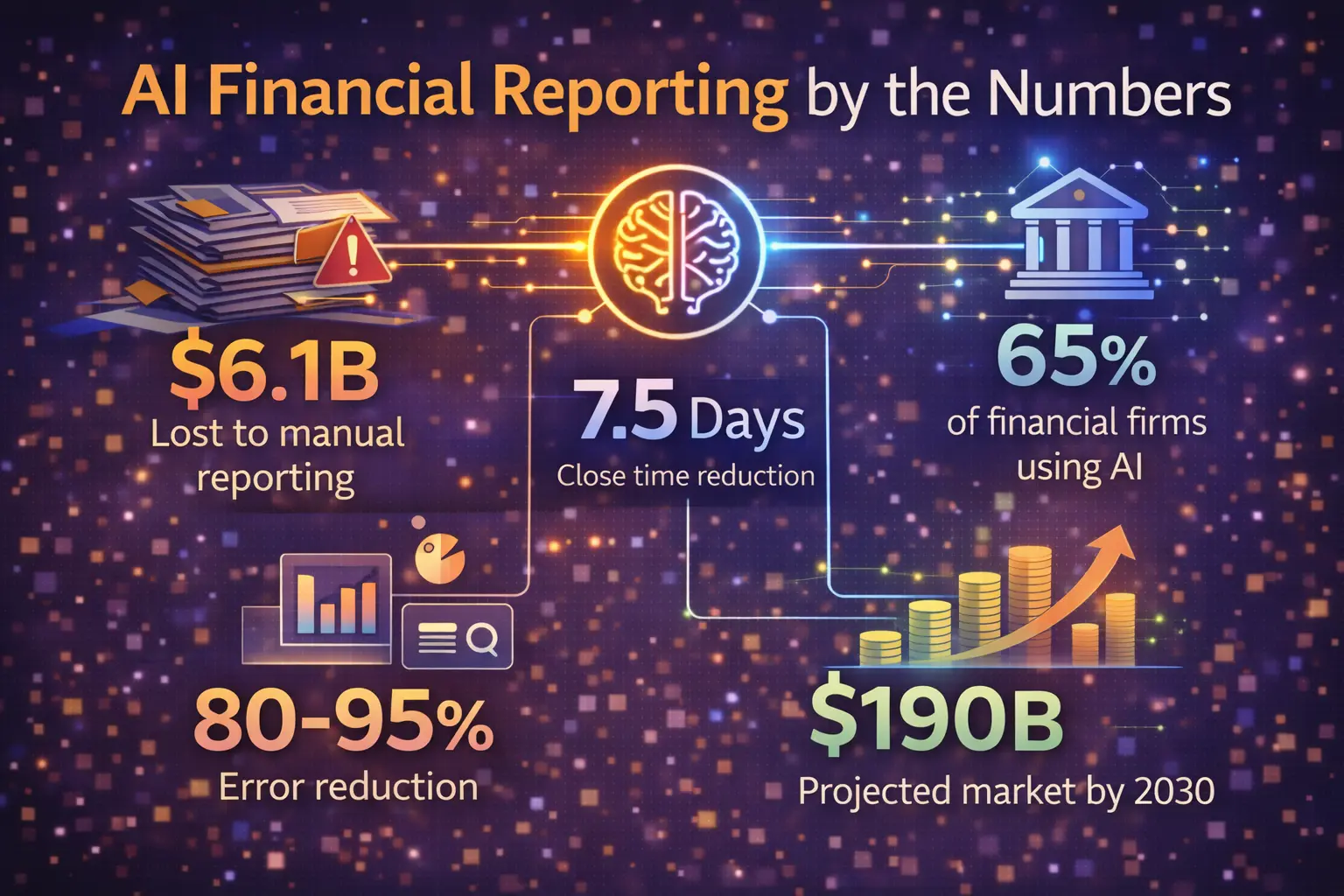
Here’s a number that should stop every CFO mid-scroll: $6.1 billion. That’s how much U.S. businesses lose every single year to manual, siloed financial reporting processes, according to research cited by The Fintech Times. Mis-keyed entries, copy-paste errors across spreadsheets, missed consolidation deadlines — it all adds up.
Automated financial reporting with AI eliminates this waste. It uses machine learning, natural language processing (NLP), and robotic process automation (RPA) to pull financial data from every corner of your tech stack, clean it, reconcile it, check it against regulations, and deliver polished reports — often while your team is still pouring their morning coffee.
The AI in the finance market reflects how seriously companies are taking this shift. It is projected that the market will be approximately 38.36 billion in the year 2024 and is likely to grow to 190.33 billion dollars in the year 2030 with a CAGR of 30.6% (MarketsandMarkets). This trend is supported by the NVIDIA 2026 State of AI in Financial Services survey, which says that 65% of financial institutions are actively participating in AI as compared to 45% just a year ago.
It is no longer a bleeding-edge experiment. It’s mainstream. And if your finance team is still wrestling with spreadsheets and manual journal entries, you’re competing with one hand tied behind your back.
The Hard Numbers: Why Businesses Are Abandoning Manual Reporting
Enough with empty promises; it’s time to discuss evidence. The statistics on AI-led financial reporting are not only promising but staggering.
The MIT/Stanford Study That Changed the Conversation
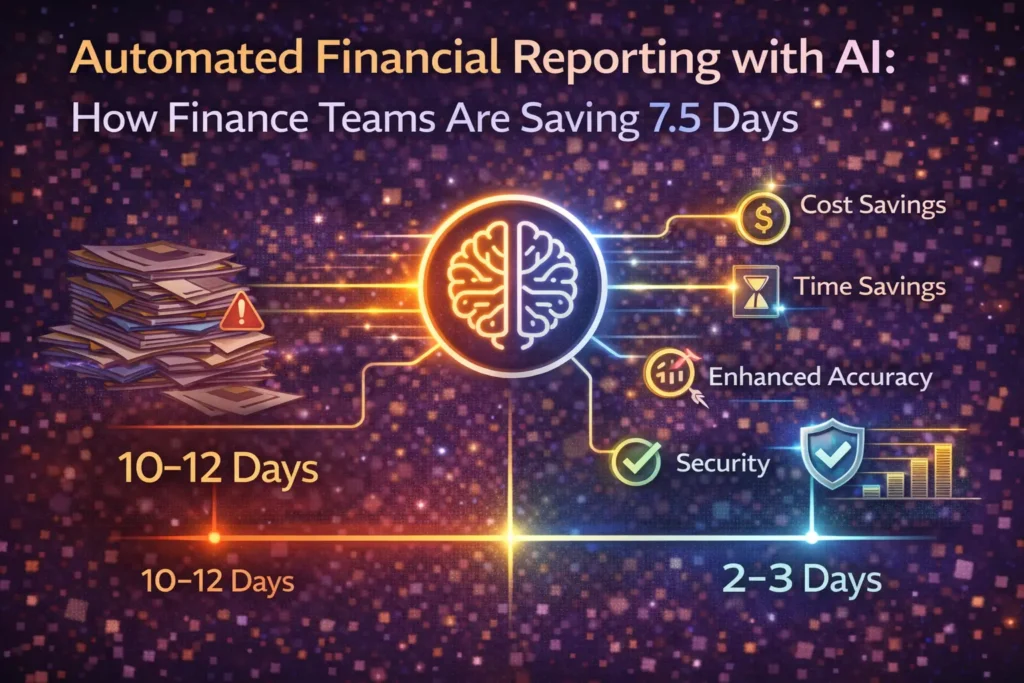
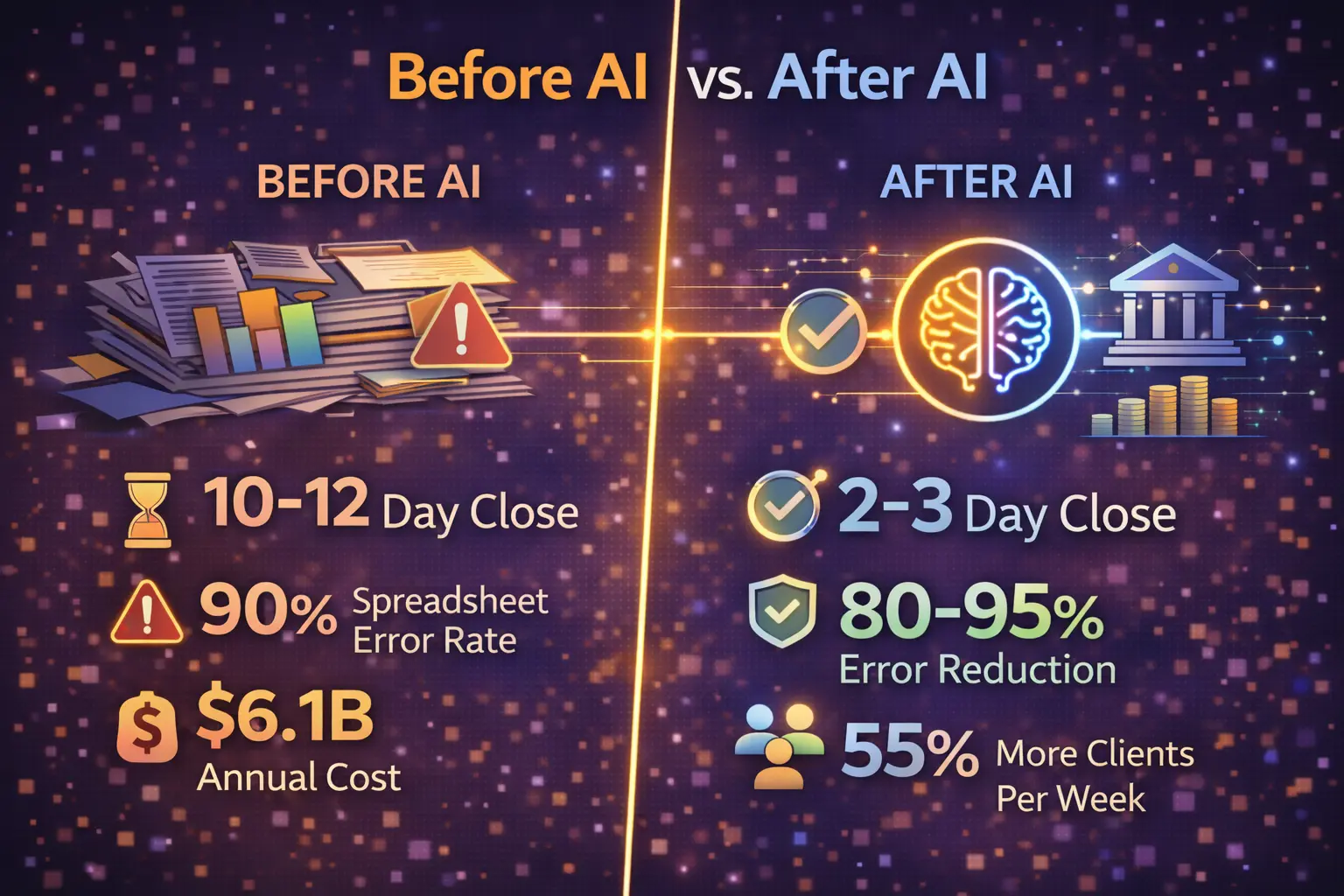
In August 2025, scientists at MIT Sloan and Stanford announced a startling study that quantified what long had been suspected by experts in the field of finance. Users of generative AI by accountants claimed that they cut monthly close time by 7.5 days – effectively closing the books a whole business week earlier. But speed wasn’t the only gain. The study also found a 12% improvement in the level of detail in financial reports, a 21% increase in billable hours, and an 8.5% shift in time away from data processing toward advisory and analytical work. Firms using AI handled 55% more clients per week.
That’s not incremental improvement. That’s a structural transformation of how accounting work gets done.
Error Rates and Compliance
Manual spreadsheet-based reporting carries a dirty secret: nearly 90% of spreadsheets contain errors, and half of the models used in large enterprises have material defects. AI-driven systems attack this problem at scale. Research indicates an 80–95% reduction in reporting errors when AI handles reconciliation and validation. According to a BILL survey of finance leaders, 75% reported fewer errors after adopting AI tools.
CFO Sentiment and Budget Allocation
The Gartner Finance AI survey (November 2025) found that 59% of finance leaders are using AI in their function. According to the CFO Connect State of AI in Finance 2026 report, 56% of finance leaders have adopted AI to date, or twice the rate as of 2023. And the spending is not decelerating: 69% of finance teams estimate to spend more on AI in the coming three years, and 13% of finance plans already spend on AI projects.
The separate finance report by Gartner has indicated that teams that are using AI-based automation are reducing close cycles by about 35%.
How AI-Powered Financial Reporting Actually Works (Under the Hood)
Awareness of the mechanics will enable you to judge the vendors confidently – and pose the right questions in the demos. This is what goes on behind the dashboard.
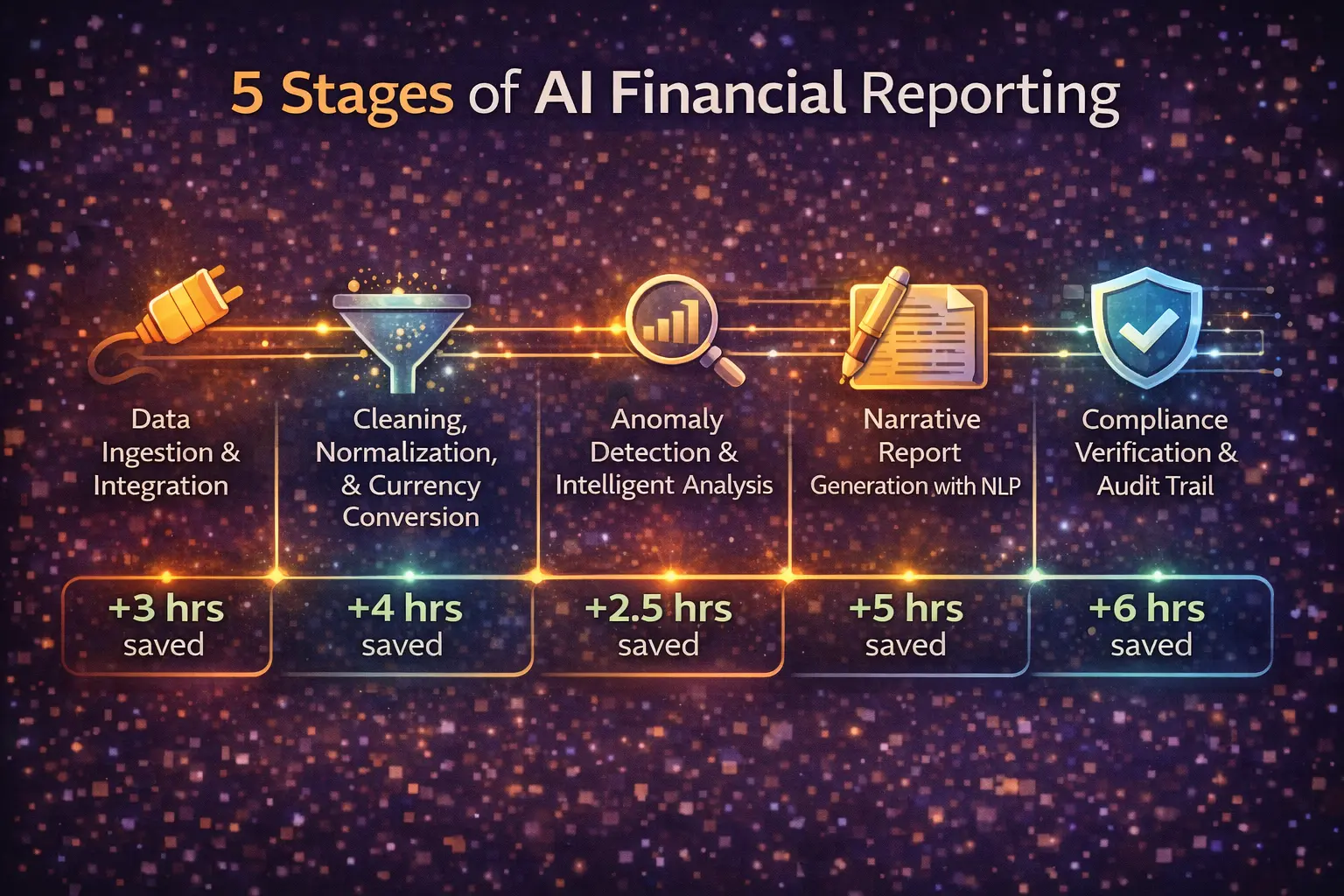
Stage 1: Data Ingestion and Integration
The AI systems connect to your existing systems through APIs and existing connectors, ERP systems (SAP, Oracle, NetSuite), accounting systems (QuickBooks, Xero), banking feeds, payroll systems, and even unstructured documents such as scanned invoices and PDF receipts. The aim is one integrated information space. Gone are the days of exporting CSVs out of five systems and manually stitching them together in Excel.
Stage 2: Cleaning, Normalization, and Currency Conversion
Your London subsidiary reports in GBP. Meanwhile, your Singapore office uses SGD. And your U.S. headquarters needs everything in USD. AI algorithms do this automatically, matching the various charts of accounts to a common framework, converting currencies using real-time rates, synchronizing fiscal years, and indicating entries that do not fit the correct pattern. What took a group of analysts a day now occurs in a few seconds.
Stage 3: Anomaly Detection and Intelligent Analysis
This is where machine learning comes in handy. Models trained on your historical data scan every transaction for outliers. If travel expenses suddenly spike 400% in a quarter with no corresponding business activity, the system raises a red flag — before it reaches your final statements, and certainly before an auditor finds it. KPMG’s research confirms that 72% of companies already using AI in financial reporting leverage it specifically for this kind of proactive error and fraud detection.
Stage 4: Narrative Report Generation with NLP
Here’s the part that genuinely surprises most finance leaders. Advanced NLP engines don’t just produce tables and charts — they write the commentary. The report may include a statement such as: Revenue was up 14.3% quarter to quarter, with the APAC region contributing most, with a 27 percent rise in the region, and operating costs were steady, with procurement savings and extra personnel costs. Such auto-generated narratives render financial reports available to board members, investors, and non-financial stakeholders of the company and make them available instantly in a format that is not raw data.
Stage 5: Compliance Verification and Audit Trail
Outputs should be cross-referenced with relevant regulatory standards before finalising the report – IFRS, GAAP, SOX, and regional tax code. It authenticates disclosures, calculates integrity, and produces a full-time-stamped audit trail of all data transformations. During external audits, this trail is worth its weight in gold.
Step-by-Step: How to Implement AI in Your Financial Reporting (Without the Chaos)
The MIT/Stanford conclusions are not only exhilarating, but they do not occur by coincidence. Companies that move too fast to implement strategies have costly shelfware. This is a time-tested seven-step implementation roadmap based on what is successful in 2026.
Step 1: Map Your Current Pain Points (Week 1–2)
Document your current reporting process (start to finish) before touching any technology. Where do bottlenecks occur? Which tasks eat the most hours? Where do errors most frequently surface? A mid-market manufacturing company might discover that 40% of its close time is consumed by intercompany eliminations — a task AI handles effortlessly. This baseline becomes your scoreboard for measuring ROI.
Step 2: Define Measurable Objectives (Week 2–3)
Such vague goals as improving reporting provide vague results. Establish targets: “Shorten monthly close by 10 days to 4 days. “Decrease the number of reconciliation errors by 80 percent. “Create 30% more FP&A time on the team. These measures provide a clear guideline on how to choose and assess your AI platform.
Step 3: Evaluate and Select the Right Platform (Week 3–6)
AI financial reporting tools in 2026 have a mature and competitive landscape. BlackLine dominates for enterprise-grade financial close and account reconciliation. FloQast excels at close management workflow for mid-market accounting teams. Workiva is the standard for SEC filings and SOX compliance documentation. Newer players such as Numeric, ChatFin, and Planful are using large language models to do more intelligent automation. Consider depending on your particular requirements: integration features, scalability, compliance coverage, NLP reports generation, and pricing model. Always demand demos with your real data, not out-of-the-box presentations.
Step 4: Build Your Data Foundation (Week 4–8)
AI systems are only as good as the data they consume. In case your financial data is disjointed, haphazard, or incomplete, then investing in data governance will pay returns first. Before plugging an AI engine into your ERP data, clean up your chart of accounts, set up naming conventions, and verify the accuracy of your ERP data.
Step 5: Integrate and Configure (Week 6–10)
Liaise with your IT department and the vendor to integrate the platform with your ERP, accounting software, and banking APIs, among other data sources. Focus on clean API integrations as opposed to manually uploading files. Customize the rules, thresholds, and templates of reporting to suit your organization.
Step 6: Run Parallel and Validate (Month 3–4)
For the first two to three reporting cycles, run the AI system alongside your traditional process. Compare every output. Identify discrepancies. Fine-tune anomaly thresholds and account mappings. This parallel period builds trust across the team and catches configuration issues before they affect live reporting. The CAP Intensity Index 2026 notes that organizations following this parallel approach report significantly higher long-term adoption rates.
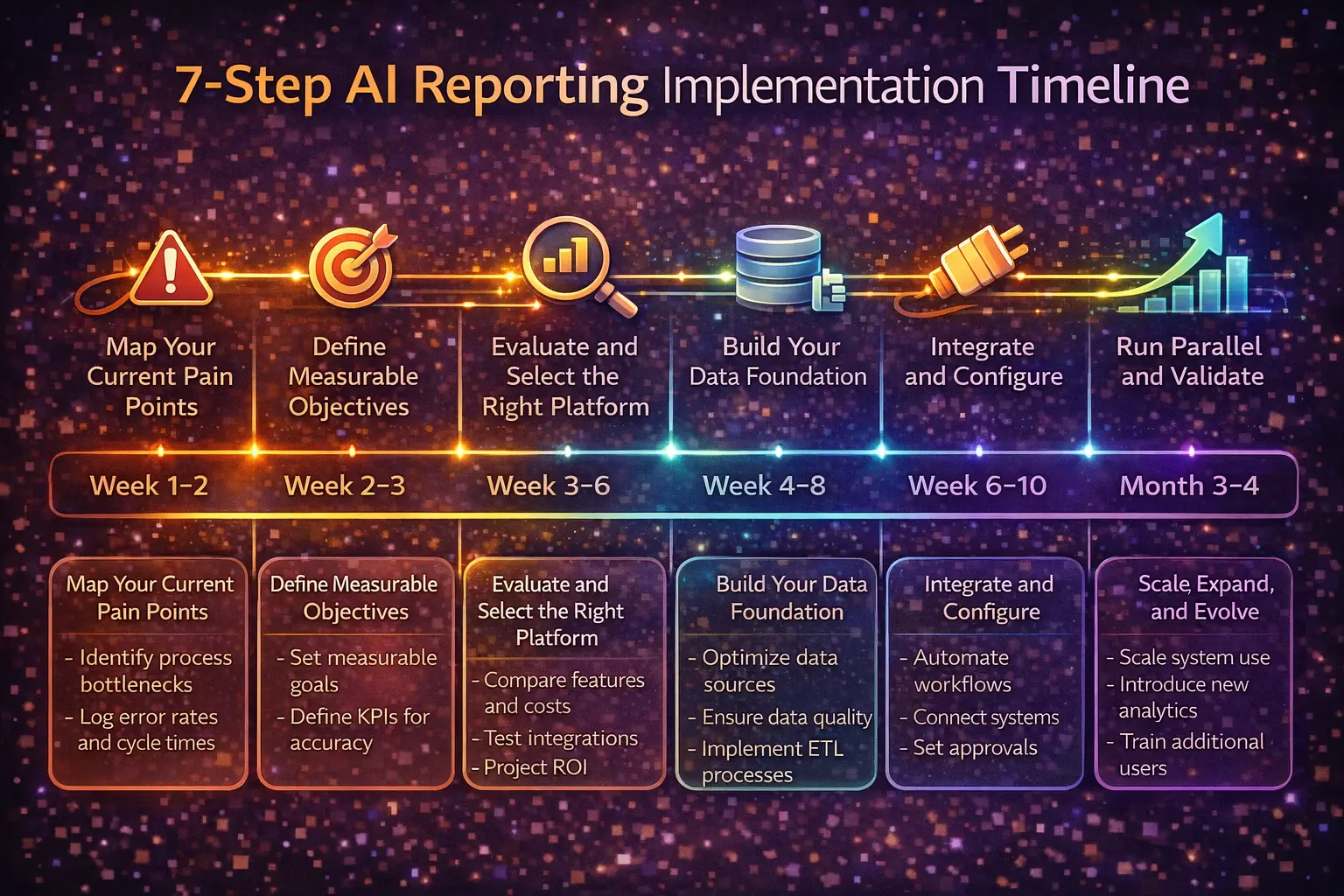
Step 7: Scale, Expand, and Evolve (Month 4+)
Starting with the establishment of confidence, start to retire manual processes. Switch quarterly to monthly AI-generated reports, to real-time dashboards. Forecasting in predictive analytics, scenario planning and cash flow. The companies that achieve the highest ROI view AI implementation as a process, rather than a project.\
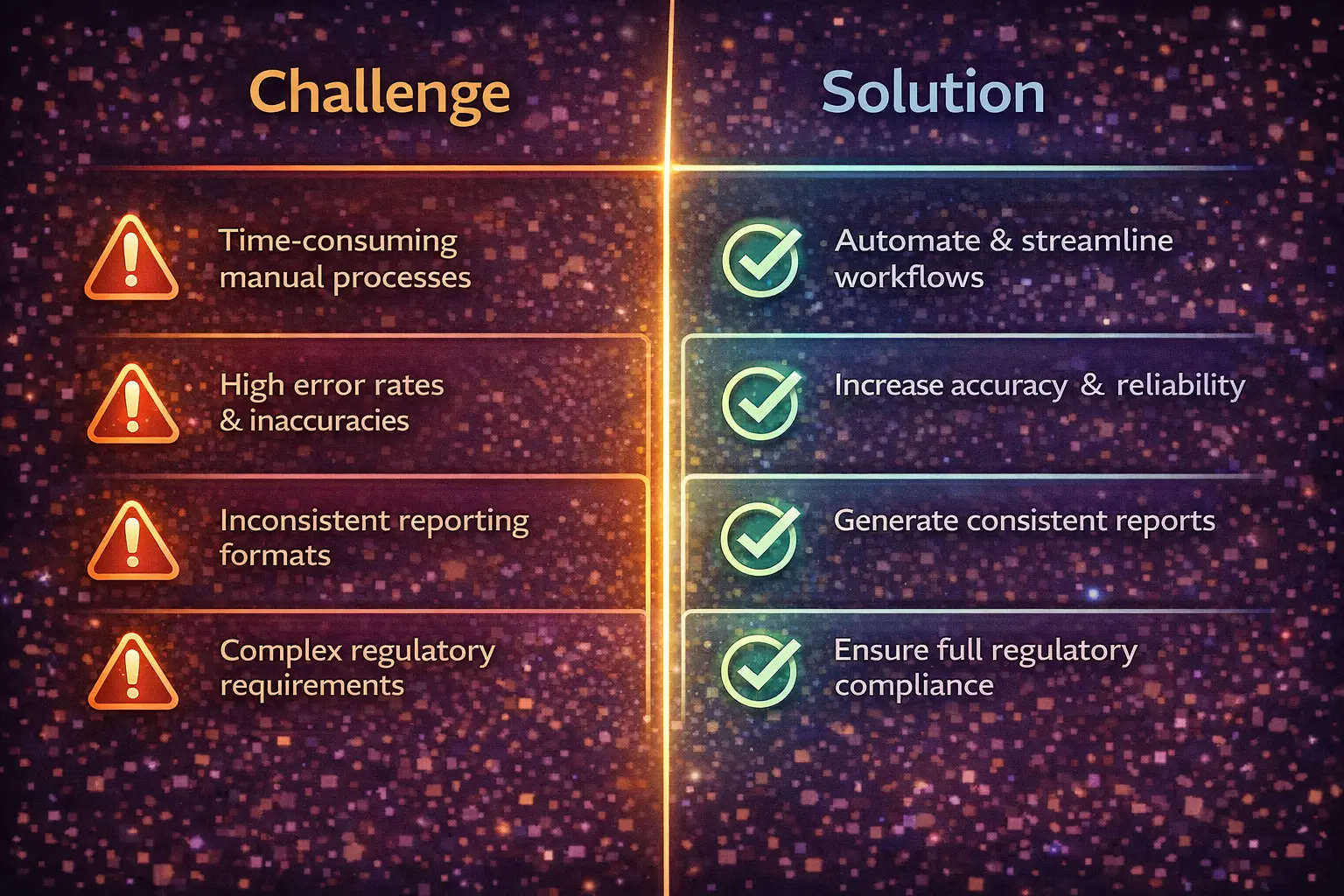
The 4 Biggest Challenges (and How to Beat Them)
No fair guide tells us that this is frictionless. The following are the traps that most organizations stumble upon, and how the successful ones have made successful.
Data quality gaps: The largest murderer of AI reporting projects is data quality gaps. When your ERP is rife with miscoded records and your subsidiaries have different account structures, AI will only exaggerate those issues, rather than resolve. The remedy: clean up and govern data prior to and not after AI deployment. Consider it as laying the groundwork before purchasing the sports car.
Change management resistance: The unspoken budget drain is change management resistance. Experienced accountants (20 years) might perceive AI as a threat and not a tool. The leadership needs to speak in a clear and repeating manner: automation is focused on the number of keystrokes, not jobs. The Stanford study, in fact, demonstrates the contrary of job loss as AI-prepared accountants were more productive and served more clients, which made them more valuable.
Security and data privacy: require no compromises. One of the most sensitive pieces of information that a company has is financial information. Make sure that the platform of your choice is SOC 2 Type II compliant, and provides both data-at-rest and data-in-flight encryption, role-based access controls, and complies with GDPR, SOX, or other applicable regulations to your business. Never compromise here.
Integration complexity can derail schedules. Old ERP systems and homemade financial databases do not necessarily cooperate with current AI systems. You need to budget sufficient time to do integration testing, and you need your IT team to be in the process right at the beginning and not as an afterthought.
The Bottom Line
Automated financial reporting with AI is no longer a pilot project sitting in someone’s innovation budget. With 65% of financial institutions actively deploying AI (NVIDIA, 2026), close times shrinking by 7.5 days (MIT/Stanford, 2025), and error rates plummeting by 80–95%, the technology has crossed from experimental to essential.
The $190 billion question isn’t whether your organization will adopt AI in financial reporting. It is either you will either be at the head of the transition, or you will have to waste the next three years trying to get to the level of competitors who have already done it.
Start with your pain points. Pick a platform. Run a parallel close. Measure the results. Scale from there. The finance teams that move now won’t just close faster — they’ll think faster, advise better, and deliver the kind of strategic value that makes CFOs indispensable.
FAQs About Automated Financial Reporting with AI
What is Automated Financial Reporting with AI?
Automated Financial Reporting with AI refers to the process of generating financial reports, processing these reports, and collecting them without human involvement. It will pull data on systems like ERP systems and accounting packages, and will automatically produce reports, such as balance sheets, income statements, and cash flow summaries, often with built-in meaning and narrative commentary..
What types of financial reports can AI generate automatically?
AI can handle almost every standard financial report you already use. It contains balance sheets, profit and loss statements, and cash flow statements, management reports, board-level summaries, tax filings and compliance reports (such as IFRS or GAAP). Most of the tools are also used to create real-time dashboards and written insights, which take hours of manual analysis.
Is AI financial reporting accurate enough to trust?
Studies have always found that AI leads to a 80-95% decrease in financial reporting errors over manual processes, mainly due to the absence of copy-paste errors, formula errors, and data-entry fatigue. The study at MIT/Stanford in 2025 revealed 12% positive change in the quality of reporting details. Nonetheless, AI cannot be trusted with everything, human control is still required, particularly when it comes to items that require judgment such as estimates and disclosures. Human-AI collaboration is the most optimal model, and not complete delegation.
Is AI-based financial reporting reliable and accurate?
Yes – AI can greatly enhance precision by eliminating human factors such as error-related mistakes when entering data manually and malfunctioning formulae. Research indicates that error reduction of up to 90% is evident in most instances. That notwithstanding, it is not entirely hands-off. Human judgment, estimates, and compliance are also complex and cannot be evaluated by machines. The fusion of AI effectiveness and human abilities produces the most impressive outcomes.
How long does it take to implement Automated Financial Reporting with AI?
Implementation time varies based on your setup. Small businesses can get started in 4–6 weeks. Mid-sized companies usually take 2–4 months, especially if they run parallel systems for validation. Larger enterprises with multiple systems and entities may need 3–6 months. In most cases, the biggest challenge isn’t the tool—it’s organizing clean, structured data.