
One e-commerce brand with a small size has employed ChatGPT to respond to customer messages, write product descriptions, and plan their daily activities, and in several months, their response time was reduced to minutes, and their content output grew twice. Stories like this are no longer rare.
Over one million businesses across the globe today are now paying ChatGPT, and over 92% of Fortune 500 companies have integrated it into their operations. Regardless of the size of the agency you serve or the scale of the business you operate in, ChatGPT for business has turned into a competitive necessity rather than an interesting experiment quicker than nearly anyone foresaw.
This guide takes you through it all: what ChatGPT really does to businesses, how to apply it to different departments, how much it costs, where it fails, and how to start doing so today. No jargon walls. No empty hype. Just practical, honest information.
What Is ChatGPT for Business?
ChatGPT for business is the application of the OpenAI conversational AI platform to automate, speed up or optimize business processes. ChatGPT is fundamentally a large language model (LLM), which comprehends and produces text in a human-like style. But to generate text is to sell it short in a manner that to play guitar is to sell Jimi Hendrix short.
ChatGPT can create emails and documents, analyze data and summarize reports, drive customer-facing chatbots, create marketing content at scale, aid with coding and technical tasks, and act as an internal team knowledge base when coupled with other applications, in a business setting.
OpenAI has a number of levels, which are directed to business usage. ChatGPT Business ($25/user/month) provides shared workspaces, admin controls, SAML SSO, and enterprise-grade security. ChatGPT Enterprise is custom-priced for large organizations (typically 150+ users) and adds unlimited access to advanced models, extended context windows, and dedicated support. There’s also a ChatGPT Pro tier at $200/month for power users who need the highest-performance models.
The critical distinction for any business: data submitted through Business and Enterprise plans is not used to train OpenAI’s models, addressing one of the biggest corporate concerns around AI adoption.
Why Businesses Are Adopting ChatGPT at This Pace
The numbers paint a stark picture. 25% of American businesses that use ChatGPT claim to save between 50,000 and 70,000 per year with 11% saving more than 100,000. According to the McKinsey study, firms invested in AI are experiencing 3-15% revenue growth and 10-20 ROI increase on sales operations.
But the raw economics are only half the story. The other half is speed.
In a business environment where a customer inquiry answered in five minutes converts at dramatically higher rates than one answered in five hours, ChatGPT’s ability to draft intelligent responses instantly isn’t just convenient — it’s a revenue driver. The same applies to marketing teams that can produce a week’s worth of content in an afternoon, or HR departments that can screen and respond to applicants in minutes rather than days.
The adoption curve reflects this. ChatGPT went from zero to 700 million weekly active users by mid-2025, and crossed 900 million weekly users by early 2026. Within businesses specifically, paid “ChatGPT for Work” seats grew by 40% in just two months during late 2025.
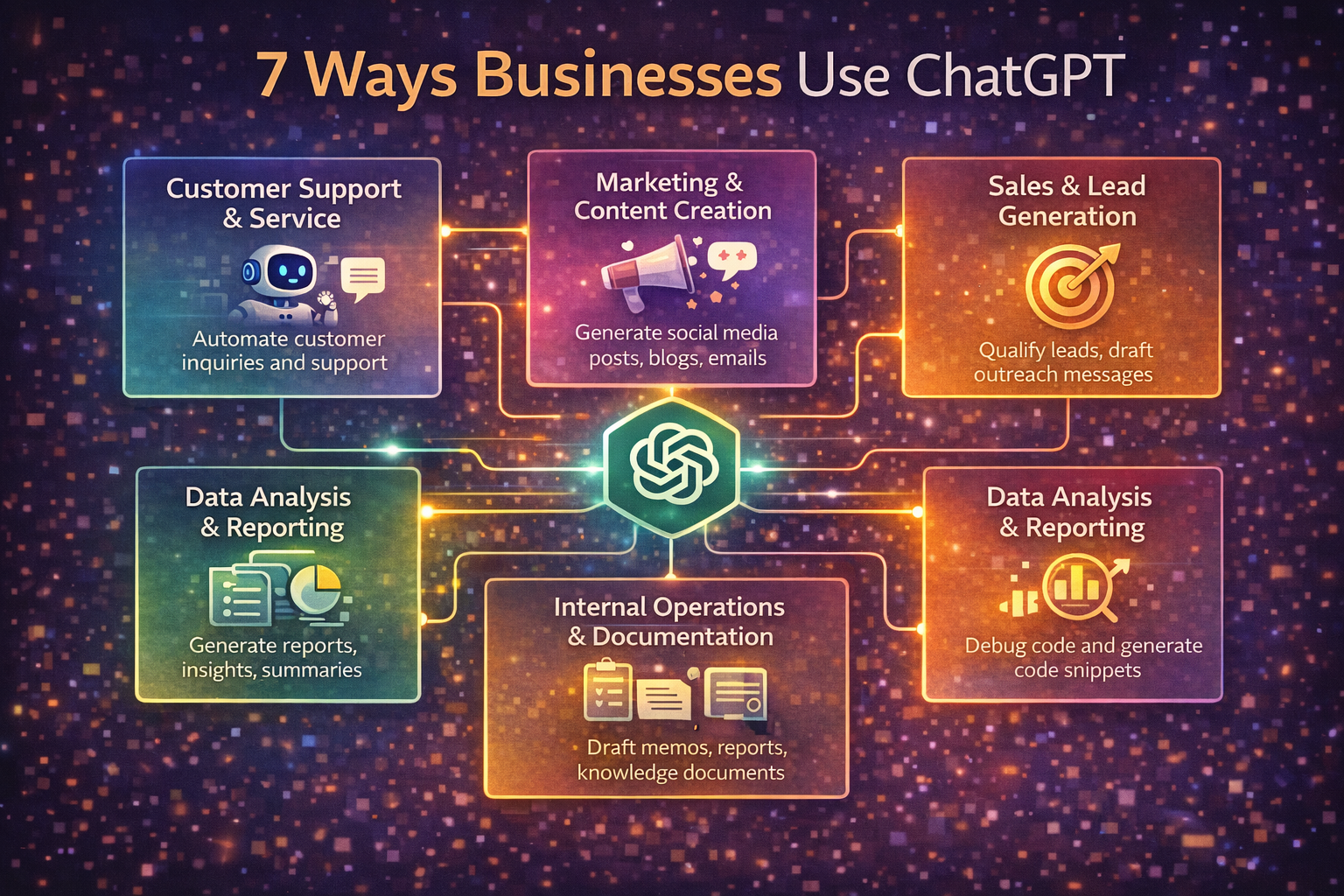
How to Use ChatGPT for Business: 7 High-Impact Use Cases
1. Customer Support and Service
It is where businesses realize the quickest, the most tangible payback. ChatGPT can drive front-line customer support by prioritizing received tickets by urgency and type, writing personalized initial replies depending on the issue of a particular customer, extracting the needed information in your knowledge base to provide an answer to frequently asked questions, and forwarding complex cases to human operators with a summary already written.
Studies indicate that customer service with the help of AI could resolve more issues by 14% and spend less time on it by 9%. According to McKinsey, the implementation of ChatGPT-level AI in customer care functions will cost 30-45% of the existing cost.
2. Marketing and Content Creation
70% of business owners report that ChatGPT provides them with a faster content generation, and 67% of CMOs are looking into AI-based personalization. The applications in this case are across the marketing funnel.
ChatGPT is capable of writing blog posts, social media captions, email newsletter text, variations of ads, product descriptions, SEO meta tags, and script outlines in a video. However, it is not the individual pieces of content that are the most effective but a content pipeline. Once you feed ChatGPT your brand voice rules, target audience descriptions and content calendar, you can call upon it to replicate the same process several times over to create a consistent, on-brand content across channels.
3. Sales and Lead Generation
AI-based sales companies record 3-5% increases in the effectiveness of sales. More specifically, ChatGPT will be able to research opportunities and summarize the news of their company within the past year, find their industry-based pain points, write individual outreach emails to numerous prospects, create pre-call brief documentations, and create follow-up messages to specific prospects, depending on their level of engagement.
4. Internal Operations and Documentation
ChatGPT is strong in the development and upkeep of standard operating procedures (SOPs), summarizing transcripts of meetings into action items with owners and deadlines, writing internal messages and policy documents, creating project plans and work breakdown structures, and developing onboarding documents to new employees.
One such potent configuration: upload your existing documentation of your company into a custom GPT (the feature of OpenAI allowing you to create custom instances of ChatGPT with specific instructions and knowledge). New employees can then query it like an always-available mentor, getting instant, accurate answers from your actual internal knowledge base.
5. Data Analysis and Reporting
The Advanced Data Analysis functionality of ChatGPT can support spreadsheets, create visualizations, discover trends, and convert raw numbers into plain-English summaries. This is revolutionary to business leaders who require insights but do not want to wait three days to get a report on the findings of the analytics team.
You can upload a CSV of quarterly sales data and ask ChatGPT to identify top-performing regions and underperforming product lines. It returns a structured summary with key takeaways, percentage changes, and even suggested areas for further investigation — in seconds.
6. HR and Recruitment
40% of HR teams are currently in the implementation stage of AI adoption. The most popular uses are to make job descriptions (30% of teams), automate communication with candidates (25%), and screen resumes or interview schedules (23%).
ChatGPT can also assist in writing performance review templates, writing offer letters, writing interview question banks based on particular roles, and summarizing profiles of candidates to be hired by managing teams.
7. Coding and Technical Assistance
63% of software developers use ChatGPT in their work. It can write code snippets, debug existing code, explain complex technical concepts, generate documentation, and create test cases. For non-technical business owners, it can also help translate technical requirements into plain language — or vice versa.
Tools That Make ChatGPT for Business Even More Powerful
ChatGPT in itself is helpful. ChatGPT will be a force multiplier to your existing business tools. The following are the most important integration platforms:
Zapier is the most user-friendly to non-technical users. Its trigger-action model allows it to be easy to create workflows such as When a new lead submits a form → ChatGPT writes a response → response is sent via Gmail. There are more than 6,000 apps to which ChatGPT can be connected via Zapier.
Make (previously Integromat) has more advanced and branching workflow features that allow users to use more sophisticated logic in their automations.
Microsoft Power Automate is a logical extension of the Microsoft 365 platform, and a suitable choice in cases when the organization is already integrated with Teams, Outlook, and SharePoint.
OpenAI API offers program access to the development of custom integrations, chatbots, and automated pipelines.
ChatGPT Business Plans: A Quick Comparison
| Feature | Free | Plus ($20/mo) | Business ($25/user/mo) | Enterprise (Custom) |
| GPT-4o Access | Limited | Yes | Yes | Unlimited |
| Ease of Use | No | Yes | Yes | Yes (highest tier) |
| Data Privacy (no training) | No | No | Yes | Yes |
| Admin Controls | No | No | Yes | Yes (advanced) |
| SAML SSO | No | No | Yes | Yes |
| Shared Workspaces | No | No | Yes | Yes |
| Context Window | Standard | Extended | Extended | Longest available |
| Dedicated Support | No | No | No | Yes |
For most small-to-medium businesses, the Business plan hits the sweet spot between capability and cost. Solo professionals often find Plus sufficient, while large organizations with compliance requirements will need Enterprise.
The Honest Limitations: What ChatGPT Can’t Do for Your Business
There is no such thing as a perfect tool and acting like you have one would be a waste of time. This is where ChatGPT fails.
Accuracy isn’t guaranteed. ChatGPT is capable and does hallucinate – creating plausible-sounding information that is factually incorrect. Any output that includes financial amounts, legal text, medical data or any other specific data should be checked by a human. Every time. No exceptions.
It lacks true business context. ChatGPT is processing the data you provide it, but does not know that your largest customer has been a silent unhappy customer, or that your supply chain is on the verge of a meltdown. Human judgment, institutional knowledge, and emotional intelligence are needed to make strategic decisions, which AI lacks.
Quality depends on input quality. Quality is based on the quality of input. Ambiguous prompts will give ambiguous outputs. Companies with the highest return invest time initially in the development of detailed prompts with well-developed structures and the development of prompt libraries to repeat tasks. The use of ChatGPT as more of a search engine than a partner will yield poor outcomes.
Security requires the right plan. On free and Plus tiers, your conversations may be used for model training. When you deal with sensitive customer information, financial data or proprietary business information, the Business or Enterprise plan is not an option, but a necessity.
How to Get Started: A Practical 5-Step Framework
Step 1 — How do you audit your time? Take a week and trace your hours. Find repetitive, text-heavy activities: email drafting, writing reports, creating content, summarizing data, responding to customers. These are your automation candidates.
Step 2 — Choose your plan. Unless you are a large-scale user, begin with Plus ( 20/month ). In case you have a team, proceed to Business ($25/user/month) to have the security and administration features.
Step 3 — Build a prompt library. Don’t freestyle all interactions. Write down, practice them out, in documented form, your 10 most frequent tasks. Add brand voice guidelines, formatting preferences, and context to each prompt. This is the highest leverage investment that you can make.
Step 4 — Connect your tools. Connect your tools. Create your first automation or Sign up to Zapier. A good beginning: New form submission Choose ChatGPT writes you a personal response → draft in your inbox to read. Keep it simple, demonstrate value, and then grow.
Step 5 — Review, refine, repeat. Regularly check the outputs of Check ChatGPT in the first few weeks. Record where it is strong, where it is weak and change your prompts. In 2-3 weeks, most of the teams reached a comfortable rhythm.
Conclusion
ChatGPT for business is not a concept of the future, but a reality of the present that is transforming the way more than a million businesses run every day. The applications of AI are wide-ranging (customer support, marketing, etc.), and the outcomes are easily quantifiable: the company can respond quicker, reduce expenses, increase production, and release teams to concentrate on the strategic work that, in fact, makes the business grow.
The companies that are achieving the best performance are not the largest budget ones. They are the ones that clearly saw their pain points, developed sturdy prompt libraries, connected ChatGPT with the tools they already possessed, and saw the technology as an ally and not a silver bullet.
The barrier to entry has never been as low. The cost is modest. The learning curve is mild. And the competitive advantage over businesses using these tools over those not is growing on a quarterly basis.
Frequently Asked Questions
What is ChatGPT for business? ChatGPT in business refers to the application of the AI platform of OpenAI to automate and improve business processes, including customer support, marketing, sales, and data analysis, and internal communications. OpenAI has custom Business and Enterprise plans that include extra security, administrative features, and information privacy.
How much does ChatGPT for business cost? ChatGPT Business will cost 25 per user/month with shared workspaces, administrator controls, and enterprise-level security. ChatGPT Enterprise is specially priced to large organizations. Individual plans are offered either free or up to $200/month (Pro tier).
Is ChatGPT safe for business use? On the Business and Enterprise plans, yes. Such levels are SOC 2 compliance, SAML SSO, GDPR and CCPA compliance, and a promise that your data will not be used to train the OpenAI models. Free and Plus plans are not provided with the same protections.
Can ChatGPT replace employees? No. ChatGPT is a productivity application that avoids repetitive and text-based tasks. It is most effective as a force multiplier that enhances your current staff and makes it more efficient rather than replacing it with additional staff. Human strengths are strategic thinking, relationship building and complex judgment.
How accurate is ChatGPT for business tasks? ChatGPT is capable of providing high-quality output when it comes to most text-based assignments; however, it tends to provide inaccurate information. Any output that requires a particular data, financial data, or legal language and medical language, should be checked by a qualified human.
Key Takeaways
ChatGPT for business is mainstream. Over one million businesses pay for it, and 92% of Fortune 500 companies have adopted it. This is no longer early-adopter territory.
The ROI is real and measurable. The companies claim to save up to 50,000-100,000 a year, cut down 30-45% of customer service expenses, and generate more revenue of 3-15% through AI-powered sales processes.
Start with your biggest time sinks. The most common and most valuable starting points are email, content creation, customer response, meeting follow-ups and data summarization.
Prompts are everything. The quality of your output is directly proportional to the quality of your prompts. Build a library. Test it. Refine it.
Use the right plan for your needs. Solo operators can start with Plus ($20/month). Teams should use Business ($25/user/month) for security and collaboration. Large organisations need Enterprise.
Always keep a human in the loop. ChatGPT is a strong writing and text generation system, but not a decision-maker. Revise the work, check facts, and use the strategic judgment, which can be offered by your team only.