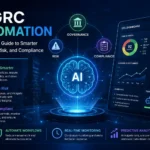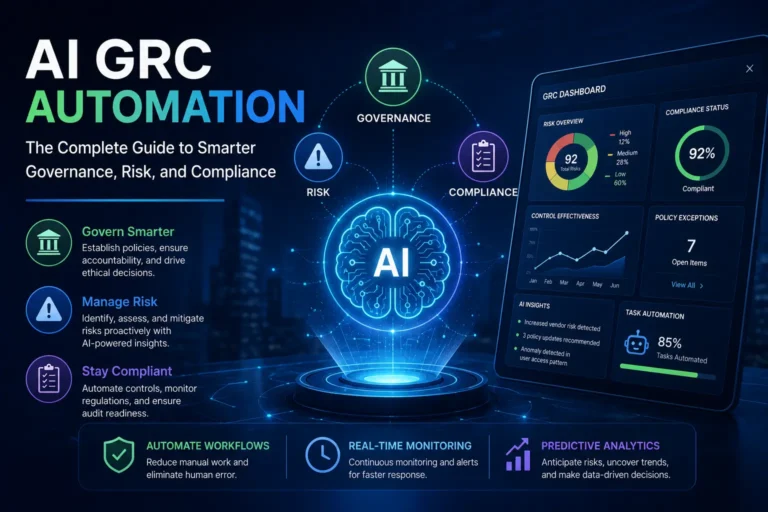
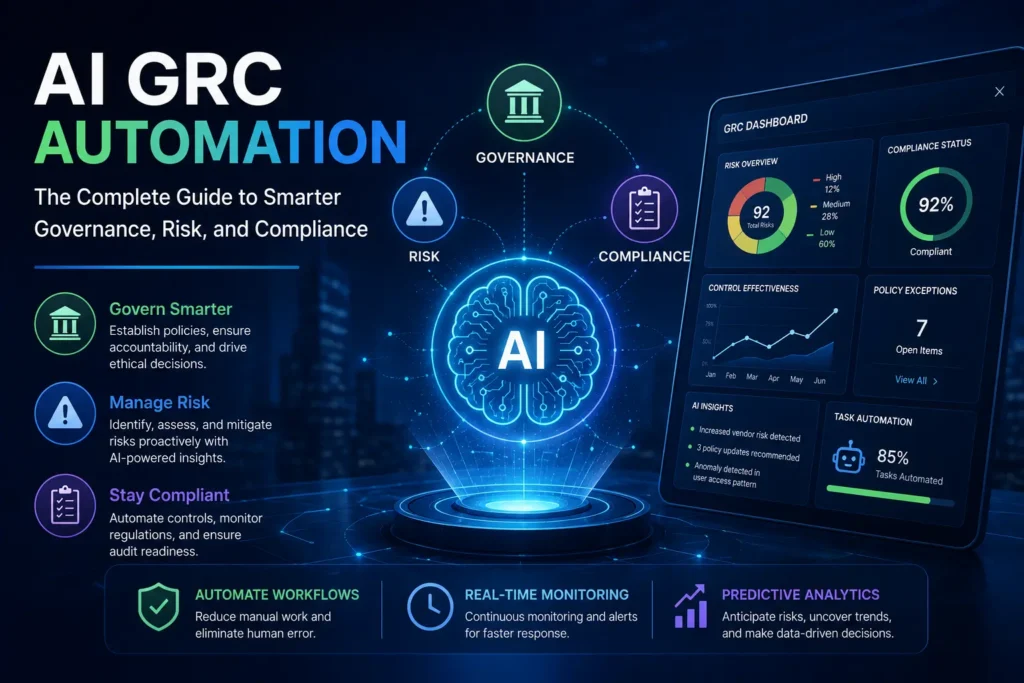
AI GRC automation is a process in which artificial intelligence is used to enhance and streamline governance, risk management and compliance practices. AI tools automate arms-length risk monitoring, automatically map regulatory updates and minimize manual failures in compliance processes. Rather than relying on spreadsheets, manual evidence collection and periodic audits. In an enterprise GRC system that is expect to grow to $83 billion by 2026 and still has 30-50% of compliance teams’ time dedicated to manual repetitive work, AI GRC automation is no longer a luxury but a necessity.
Featured Snippet Summary: AI GRC automation uses artificial intelligence to automate governance, risk, and compliance tasks such as continuous monitoring, regulatory tracking, evidence collection, and risk assessment — reducing manual workload, cutting costs, and improving accuracy across the compliance lifecycle.
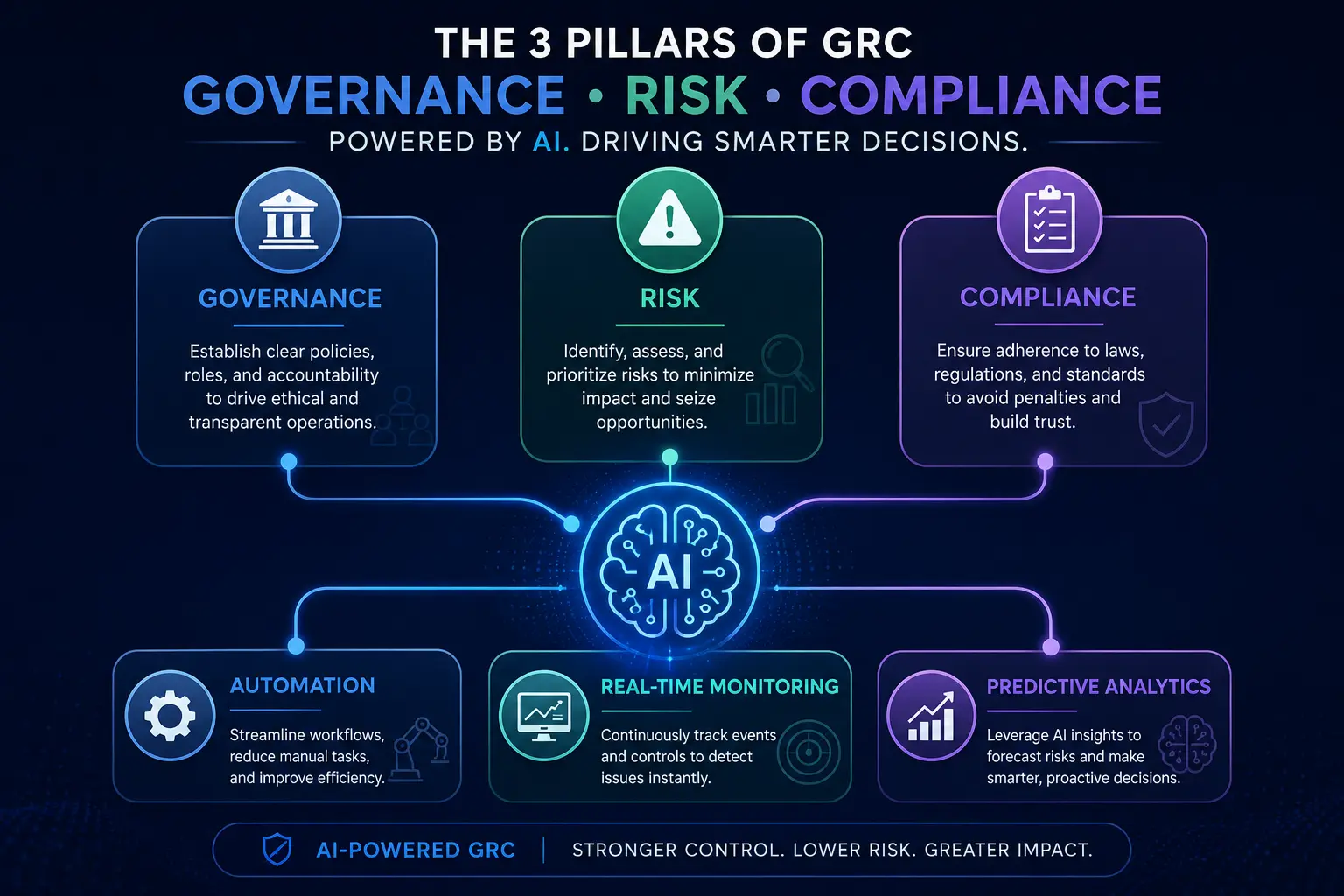
What Is AI GRC Automation and Why Does It Matter?
Governance, risk, and compliance (GRC) has, in the past, been a time consuming task. Compliance professionals must collate evidence from an extensive number of sources, monitor regulatory changes from hundreds of sources and create audit documentation in spreadsheets that quickly become obsolete. Half of all compliance professionals report dedicating 30% to 50% of their time to manual and repetitive tasks, which is an incredible amount of time at a time when Thomson Reuters Regulatory Intelligence is monitoring more than 200 regulatory changes per day across the globe, according to Hyperproof’s 2025 IT Compliance Benchmark Survey.
AI GRC automation addresses this issue by integrating AI, NLP, and intelligent workflow engines into the compliance journey itself. These tools can automatically ingest new regulations, match them to existing controls, highlight gaps, gather evidence from connected systems, and create audit-ready reports — without having to start each step manually.
It is urgent that this happens. This IBM 2025 Cost of a Data Breach Report reveals that businesses that were leveraging AI and automation extensively recorded an 80-day reduction in their breach lifecycle, resulting in an average savings of nearly $1.9 million over businesses doing without automation at all. In an era where breaches take a mean 241 days to be identified and contained – and where a third party’s involvement in breaches has doubled to 30% – reactive and manual GRC programmes simply cannot keep up.
Key Benefits of AI GRC Automation
Continuous Risk Monitoring Replaces Point-in-Time Reviews
Conventional compliance programs are based on annual and/or quarterly audits. AI GRC automation allows for 24/7 monitoring, scanning, vendors, and regulatory feeds. This is from a reactive to a proactive model, and that has a massive impact on what can only be called blind spots between scheduled reviews.
Dramatic Reduction in Manual Workload
In this way, AI allows compliance professionals to dedicate more time to interpretive compliance work, such as reading in between the lines, making risk-based decisions, and guiding the business on strategic compliance issues. With 95% of organisations reporting that there are skills gaps, when it comes to cybersecurity, it’s important to redirect limited resources from repetitive activities.
Lower Compliance Costs with Higher Accuracy
The Ponemon Institute has long estimated that the average cost of non-compliance is 2.7 times the cost of maintaining compliance. AI automation reduces both sides of that equation — it makes maintaining compliance cheaper through efficiency while reducing the risk of non-compliance penalties through accuracy and speed.
Faster Audit Readiness and Deal Velocity
Security questionnaires, SOC 2 reviews and vendor assessments now lengthen the sales cycle by two to four weeks for both mid-market and enterprise sales. AI-driven GRC tools that automatically collect evidence and produce audit reports can make compliance a revenue generator rather than a roadblock, saving a lot of time.
The Rise of Agentic AI in GRC
A second big trend projected to define AI GRC automation in 2026 is the emergence of agentic AI – AI agents that can work on their own to carry out multifaceted tasks, make decisions within a certain context, and adapt to varying circumstances without human input. By 2028, Gartner estimates less than 1 percent of enterprise software applications will contain agentic AI, whereas in 2025, the figure will be 33 percent.
In GRC scenarios, agentic AI can automatically track third-party vendor risk positions, identify access control issues, prepare answers to compliance questionnaires, and even develop remediation strategies for risks. But there’s a warning there: Gartner also predicts that over 40% of agentic AI projects will be scrap by the end of 2027 because of limited value and insufficient risk management. Those that will prevail will combine agentic automation with disciplined governance structures and accountability of humans.
This is especially true when the use of AI for compliance is itself a compliance domain. Organizations are facing new challenges and requirements, such as the EU AI Act, ISO 42001 and the NIST AI Risk Management Framework. The market for AI governance platforms is expected to grow to $492 million in 2026 and over $1 billion by 2030. AI GRC automation is thus both a tool to automate compliance to current rules and also a way to govern one’s own AI systems.
Common Challenges and How to Overcome Them
There are always challenges to every implementation. The most common obstacle is data quality — the quality of data that the AI model ingests will ultimately determine the quality of the results, and organizations with data that is fragmented and inconsistent across systems will need to invest in data normalization before they can realize a meaningful benefit from AI. Another typical challenge is resistance to change within compliance teams, which can be overcome by showing early wins and having team members participate in configuring the platform instead of imposing it from above. Last, automation leads to complacency if humans aren’t involved. The optimal AI GRC solutions recognize the importance of human judgment and decision-making, and use automation to support it.
Conclusion
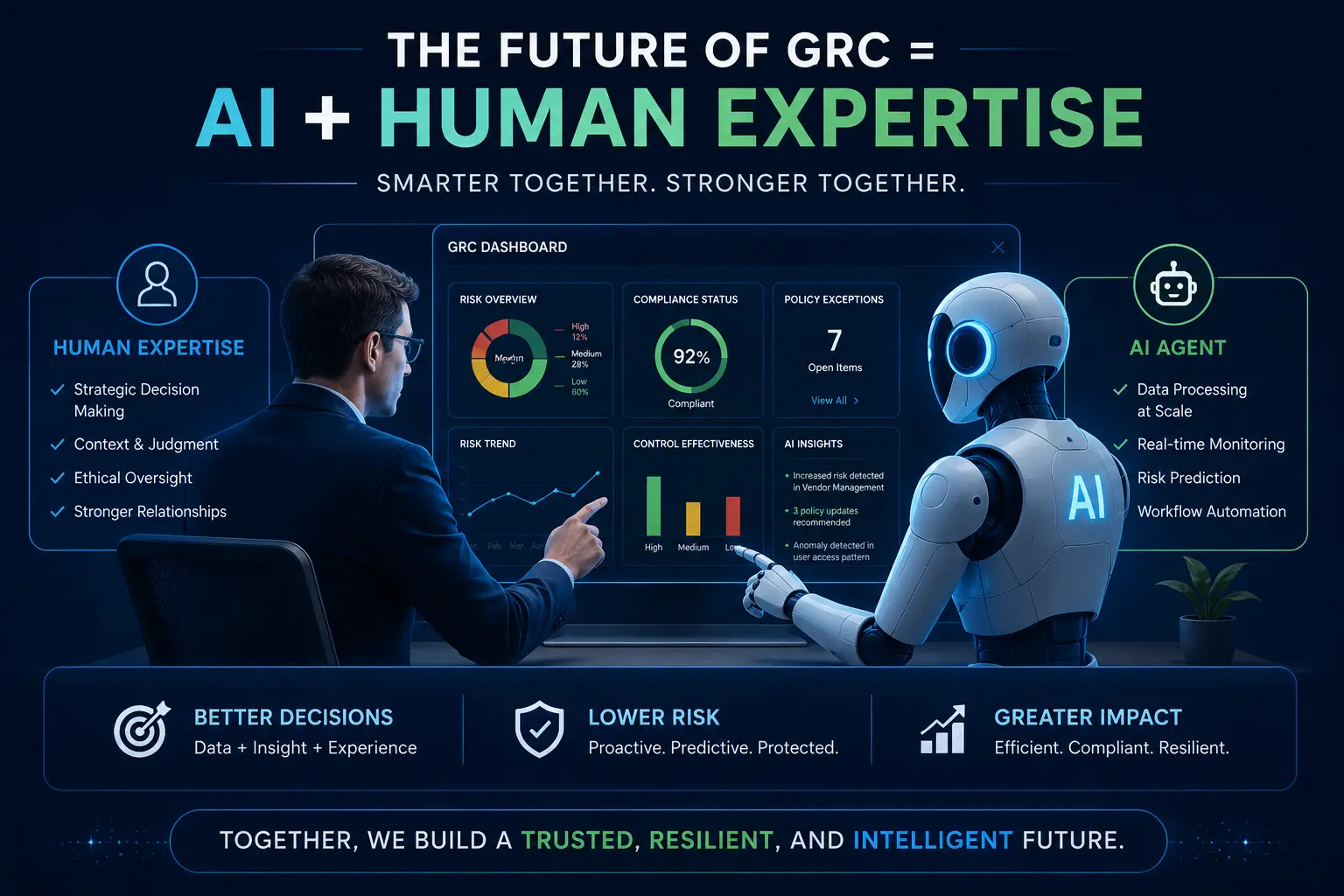
The implementation of AI GRC automation is a paradigm shift in the way organizations approach governance, risk and compliance. As the rules change every day, mistakes only come to light after months of effort, and compliance teams are already overwork with manual workloads and lack of skills. AI-powered automation is the only way for compliance to scale. The facts and figures speak for themselves: those that integrate AI into their GRC programs are faster to identify threats, less expensive with compliance, and more successful. The secret is taking the process of implementation in a step-by-step process: asses the maturity, select the appropriate platform, embed it thoroughly and do not forget the human dimension. The future of GRC is not that machines replace the people. It’s all about empowering people with smart tools to effectively manage in a world that is moving at a pace faster than any spreadsheet ever could.
FAQs About AI GRC Automation
What is AI GRC automation?
AI GRC automation refers to the use of artificial intelligence technologies, including machine learning, NLP and agentic AI, to automate governance, risk management, and compliance (GRC) activities. It makes smart, automated, scalable processes for evidence collection, regulatory monitoring and control mapping and audit preparation, among others, more efficient and less time-consuming than traditional, manual processes.
How does AI GRC automation reduce compliance costs?
By automating repetitive tasks that currently consume 30–50% of compliance professionals’ time, AI GRC tools reduce labor costs and human error. IBM’s research shows organizations with extensive AI and automation save nearly $1.9 million per breach incident. Additionally, maintaining automated compliance is significantly cheaper than paying the penalties associated with non-compliance, which the Ponemon Institute estimates at 2.7 times the cost of compliance.
What are the best AI GRC automation tools in 2026?
The primary risks include incorrect outputs generated by AI, inadequate human oversight over AI applications, becoming dependent on using only a single platform, and handling. The AI tools under new regulations like the EU AI Act and ISO 42001. Organisations must go on a journey toward AI GRC automation, and need to have a human step of review over major decisions, as well as over the traditional compliance step.
Is AI GRC automation suitable for small and mid-sized businesses?
Yes. There are many modern AI GRC platforms that have tier pricing and are tailor to suit the needs of an SMB who wants to meet standards like SOC 2 or ISO 27001 without a big compliance team. Platforms such as Vanta and Drata have found tremendous success with startups and mid-market sized organizations, just because they take care of what might otherwise need a compliance specialist on staff.
What risks should organizations watch for when implementing AI GRC automation?
The primary risks include incorrect outputs generated by AI. Inadequate human oversight over AI applications, becoming dependent on using only a single platform, and handling. The AI tools under new regulations like the EU AI Act and ISO 42001. Organisations need to take a step-by-step approach to AI GRC automation, have a human layer of review over critical decisions, and develop human competency in AI governance as well as the traditional compliance area.