What Is AI Automation of Routine HR Tasks?
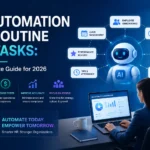
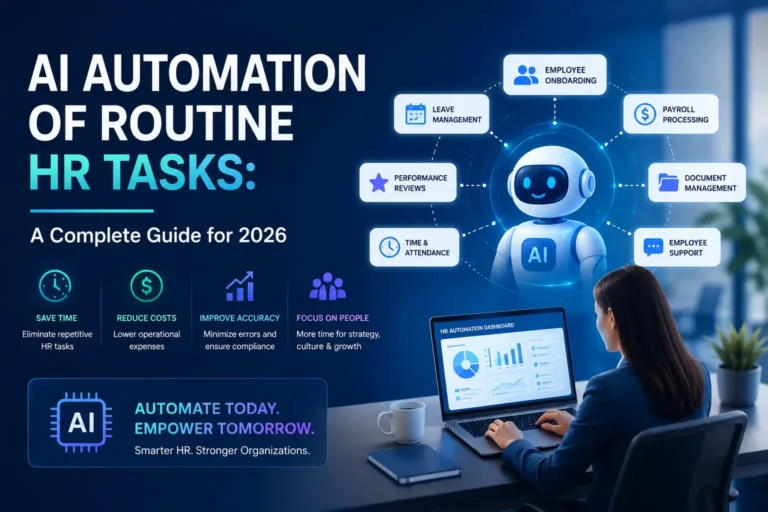
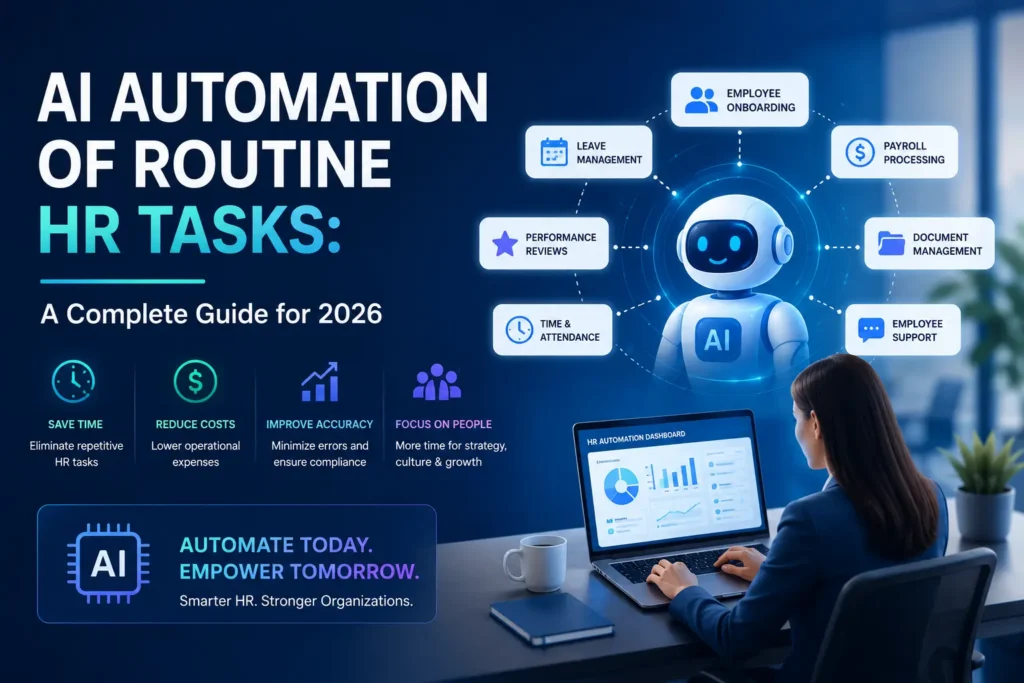
HR teams tend to have a hundred or more tedious tasks to complete each day. AI automation of routine HR tasks refers to the use of artificial intelligence, such as machine learning, natural language processing, and robotic process automation, to manage repetitive HR tasks without relying on human intervention. Some of these include screening resumes, payroll management, employee induction, attendance tracking, benefits administration, and addressing typical employee inquiries.
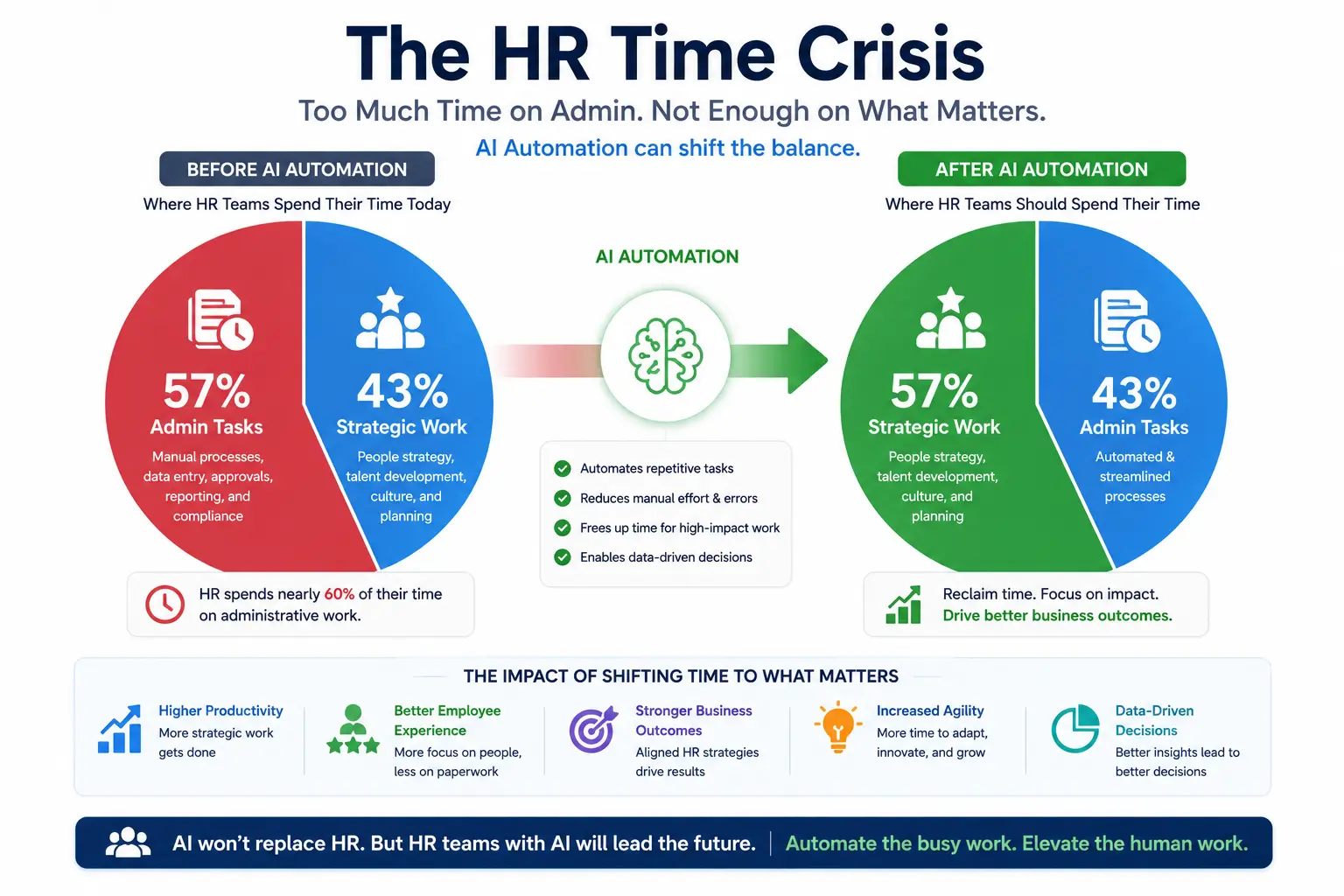
The truth is that HR professionals dedicate as much as 57% of their time to administrative and routine tasks, according to a study by Deloitte. That equates to over half of all HR professionals’ time being spent on paperwork, data entry and repetitive tasks that don’t contribute much to strategic thinking. By automating that time, HR teams can shift their focus to what really matters: people strategy, talent development and culture.
It’s no future trend – 92% of companies plan to boost their AI spending over the next three years (McKinsey). This is the current competition benchmark.
Why HR Teams Desperately Need AI Automation Right Now
The argument in favor of AI automation in HR isn’t abstract. It is urgent.
The HR sector sees a growing concern that the volume of work is outpacing the number of staff, as 56% of HR professionals (SHRM 2023-2024 State of the Workplace Report) said their HR teams were understaffed to handle the workload. Consequently, 57% of HR professionals are working overtime to meet the minimum administrative needs.
Add to that the fact that just 19% of HR professionals predict they’ll be grant more staff in the near future, and the issue becomes even more difficult. The leadership message is simple – do more with less. That’s the only practical way to get there without exhausting your employees and that’s where AI automation comes in.
In the meantime, the scope of HR has grown immensely. Hybrid working arrangements introduced the challenge of adding onboarding and offboarding. Multi-jurisdictional compliance needs. Staff no longer accept that they have to deal with paper or phone to sign up for benefits or get training.Staff no longer tolerate the need to sign up for benefits or training through paper or phone. The number of employees was the same, but the work load grew.
That’s why, according to Aptitude Research, 60% of HR and IT leaders upped their investment in automation tools. They knew that the manual workflows just can’t scale to today’s needs.
Which HR Tasks Can AI Automate Most Effectively?
Recruitment and Candidate Screening
The recruitment process is the biggest time-consuming part of every HR department’s responsibilities and the one that AI can make the most impact on. An applicant tracking system that uses artificial intelligence to filter out thousands of resumes in seconds, match candidates’ skills with job requirements, and rank them by their suitability.
The numbers do tell a story. You can save up to 50% of your time to hire with AI, and resume screening is the fastest area to make a dramatic improvement (Taleva, 2025). Companies implementing AI recruitment systems claim to have cut their cost-per-hire (CPH) by 30% (SHRM). And 86.1% of recruiters that employ AI have attested that it has had a measurable impact on their hiring process.
In addition to speed, AI is helping to make the transition to skills-based hiring. 85% of employers are using some methods of skills-based hiring today, while 81% did so in 2024 (TestGorilla). This method yields better results: 94% of employers would agree that skills tests are more predictive of on-the-job success than would a traditional resume review.
Employee Onboarding
The retention is directly affected by a poor onboarding experience. Gallup reported that 78% of workers believe that their organization doesn’t do an excellent job onboarding. As many as 20% of employees leave within 45 days or less, frequently feeling disorganized, impersonal and/or confused about the process.
AI-powered onboarding systems transform this scenario altogether. New employees are directed to the correct documents to be submitted, policies to be accepted and training to be completed by the chatbots. Automation ensures that all the tasks are performed in proper sequence and within the right time frame. They’ve been able to reduce the onboarding period from a week to a day using automated solutions for one of their case studies at Outfittery – a reduction of 80%.
Payroll and Benefits Administration
While payroll is 97% digitized already, across organisations. AI extends this to identifying anomalies, forecasting errors before they can happen and adjusting to regulatory changes across different jurisdictions automatically. Businesses implementing automated payroll solutions say they save an average of 37% in payroll administration time and 46% in payroll and employee data management time (Forrester).
Employee Query Resolution and Support
HR staffers get the same queries again and again: leave balances, clarifications on policies, eligibility for benefits, payroll dates. These queries can be answered by AI chatbots instantly and 24/7. In the last two years, HR automations have increased 599%, with HR bots now being part of 39% of employee automations, according to SHRM. This allows HR personnel to concentrate on complicated and sensitive discussions that truly need the human touch and judgment.
Performance Management and Analytics
Performance management tools powered by AI automate peer reviews, set up check-ins, and analyze the feedback patterns. In the case of feedback, companies employing these solutions claim to save as much as 180 hours (Deel case study). In addition to saving time, 46% of HR professionals state that AI has improved their analytics capabilities, helping them make informed decisions regarding compensation, promotion and workforce planning.
Real Results: What Companies Are Actually Achieving
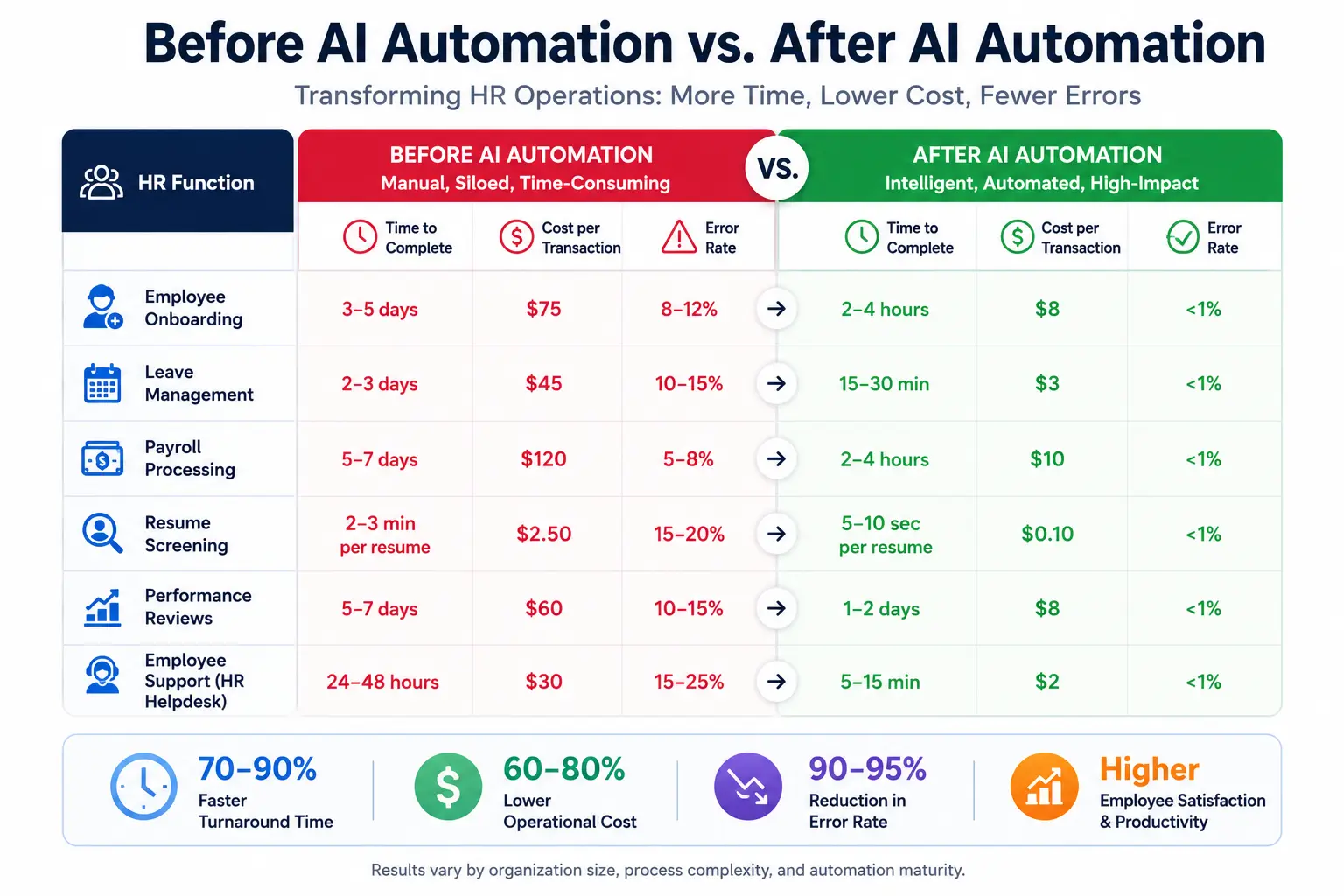
The statistics are not figures from out of a hat. Companies are seeing truly revolutionary results with AI automating HR.
AI recruitment platforms (TestGorilla) can save companies an average of $2,342 per hire and 792 hours per hire. Companies which adopt full HR automation are able to get back more than 40% of their manual tasks. 85% of employers that use automation and/or AI say it saves time and boosts their efficiency (SHRM).
Perhaps most significantly, 65% of companies surveyed say AI has significantly enhanced efficiency and productivity in HR management tasks (Engagedly). They aren’t early adopters looking for results, they are organisations measuring actual operational improvements.
Addressing Common Concerns About AI in HR
Will AI Replace HR Jobs?
No. The statistics across the board are that AI is transforming HR rather than replacing it. As admin goes down, HR moves to strategic: workforce planning, culture development, employee relations and organizational design. The role is ascending in value.
What About Employee Trust and the Human Touch?
This is an appropriate and realistic concern. AI is not well accepted in the recruiting and hiring process, with over 65% of people feeling uncomfortable with it (ServiceNow) and 40% of the top people in the talent acquisition industry feeling unsure of how AI is too impersonal in the recruiting process (Korn Ferry).
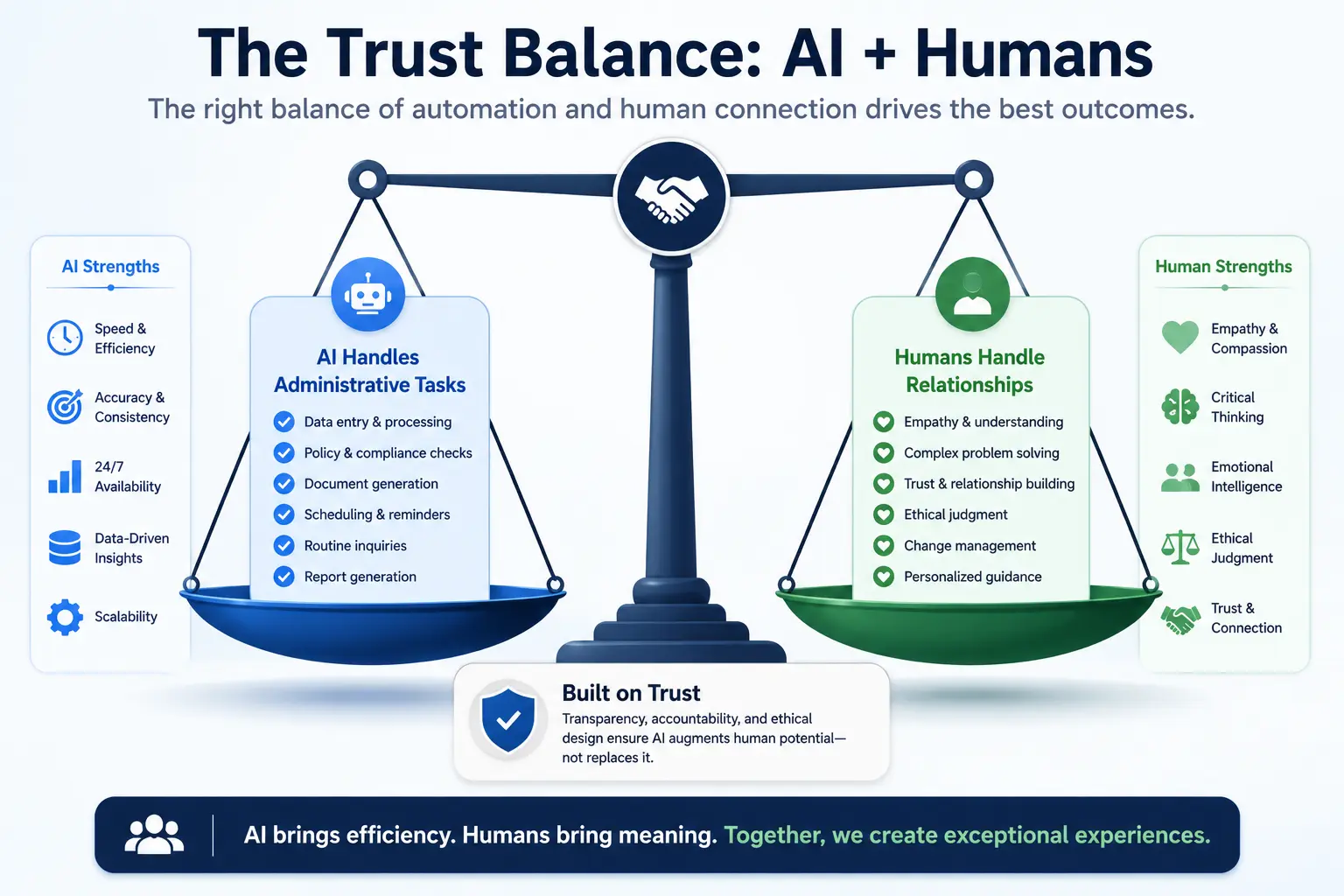
The answer is not less automation, it is smarter automation. Use artificial intelligence to automate administrative duties and allow people to be involved in more relationship-based interactions. Such as interviews, sensitive communication, career development and conflict resolution.
Is My Organization Ready?
Frankly, it is not likely 100 percent, and that’s perfectly fine. AI Maturity is reached by only 1% of business leaders (McKinsey). However, you don’t have to be ready to begin. It’s a skill that must be learn through practice. Start simple and get results: start small and grow up the capability of the organization.
The Cost of Waiting
But many HR leaders are unaware of this accruing expense – not automating. At least half of your team’s time is spent on administrative work without time to spend on talent pipelines, culture, turnover and strategic initiatives. On a larger scale that translates to losing hundreds of thousands of dollars in productivity annually.
According to Gartner, 76% of HR leaders are lagging if they are not to implement AI solutions in 12-24 months.AI solutions are becoming a must-have for HR leaders, with 76% of HR leaders noting they will be behind the curve without implementing them within the next 12-24 months (Gartner).
Conclusion: Your Next Move Matters
AI automation of routine HR tasks is no longer experimental. It’s proven, measurable, and more and more, the need of any business that wishes to be efficient and competitive for talent. The numbers speak for themselves: 50% faster hires, 30% reduced hiring expenses, 57% of administrative time saved, and higher levels of employee satisfaction.
Weekly Action Plan: Audit one HR process – choose the most time-consuming repetitive process your team carries out. Find the total number of hours it uses in a month. Afterwards conduct a search for 3 AI solutions that might solve it. Book one demo. With that one step you’re ahead of most organisations that are still using manual processes.
Those that move forward will create compounding benefits in talent acquisition, employee experience, and operational efficiency. The ones waiting will get into a situation of playing with one hand tied behind their head.
Frequently Asked Questions
How much time can AI automation save HR departments?
According to research from Deloitte, HR professionals are spending up to 57% of their current time on administrative tasks which could be automate by AI. Companies using AI tools claim that they’ve saved 37-50% of their time spent on repetitive manual tasks. Such as payroll management, sorting resumes, and answering employee queries. In one known instance, 120 hours were save each month on payroll alone.
What is the ROI of AI automation for HR tasks?
AI in the recruitment process can lower the cost-per-hire by as much as 30% (SHRM) and save an average of $2,342 per position (TestGorilla). Companies also report 50% reduction in time-to-hire, 80% faster onboarding and major reduction in compliance-related errors. Return on Investments are realize in 3-6 months for most organizations.
Which routine HR tasks should be automate first?
Begin with tasks that involve numerous rules, repetition, and high volume. Commonly effective starting points include resume screening, candidate shortlisting, employee query resolution via AI chatbots, payroll management, leave and attendance management, and onboarding document workflows. The processes provide the quickest time-to-value and lowest implementation risk.
Is AI automation of HR tasks safe for employee data privacy?
AI HR tools, when implemented with the right governance, have high data security. Organisations must do all they can to ensure that vendors adhere to the regulations. Including GDPR and local data protection directives – have suitable encryption policies and policies to manage access by staff. And communicate with them about the data they handle and why. 53.87% of job seekers are worry about privacy today, so it is essential that data practices are transparent, to foster trust.
Will AI automation make HR departments impersonal?
Not when it is well premeditate. The best companies use AI to streamline processes and still allow for human engagement in key areas such as interviews or career development meetings, conflict resolution and delicate employee matters. The results of a thorough employer study indicate that 65% of the population does not feel comfortable with the use of AI in the recruitment process, making it crucial to use AI where it fits and people where it fits.