
AI is not a futuristic idea; it’s a skill being adapt by businesses and professionals to save time, eliminate repetitive tasks and boost productivity. As this need continues to rise, getting start with an AI automation bootcamp is an appealing learning trajectory for entrepreneurs, marketers, techies, and novices looking to grasp the genuine impact of automation. These are short courses that are practice-based and allow students to build their own workflows, automate tasks. And learn how to use AI tools to enhance daily tasks instead of spending months studying complicated theories. From enhancing career development to optimizing business workflows, an AI automation bootcamp can be a wise initial move toward the future of digital work.
Why AI Automation Bootcamps Are Exploding in Demand
AI Automation Bootcamps are gaining immense popularity for good reason.There’s a reason behind the growing popularity of AI Automation Bootcamps.
There has been a fundamental change in the workplace. Automating manual processes, lowering operational expenses and scaling up production without adding so many resources are the primary goals of every business that is rushing to automate its processes in every way possible. As per latest workforce reports, the demand for professionals with knowledge of AI-driven automation has increased by a huge margin since 2024.
There just simply aren’t enough places to provide a traditional degree program that can keep up with the pace of change of tools. An AI automation bootcamp is where it fits in. These programs are design to take months of self-study, and pack it into structured, on-the-job curricula, supervised by practitioners working in the field every day.
From the solopreneur who wishes to automate the client onboarding process to the data analyst aiming to incorporate predictive models into business pipelines, the ideal bootcamp can shorten the learning curve from years to weeks.
What You Actually Learn in an AI Automation Bootcamp
While each program may have its own unique approach, there are some common threads of skills and tools found within the more reputable AI automation bootcamps.
Core Technical Skills
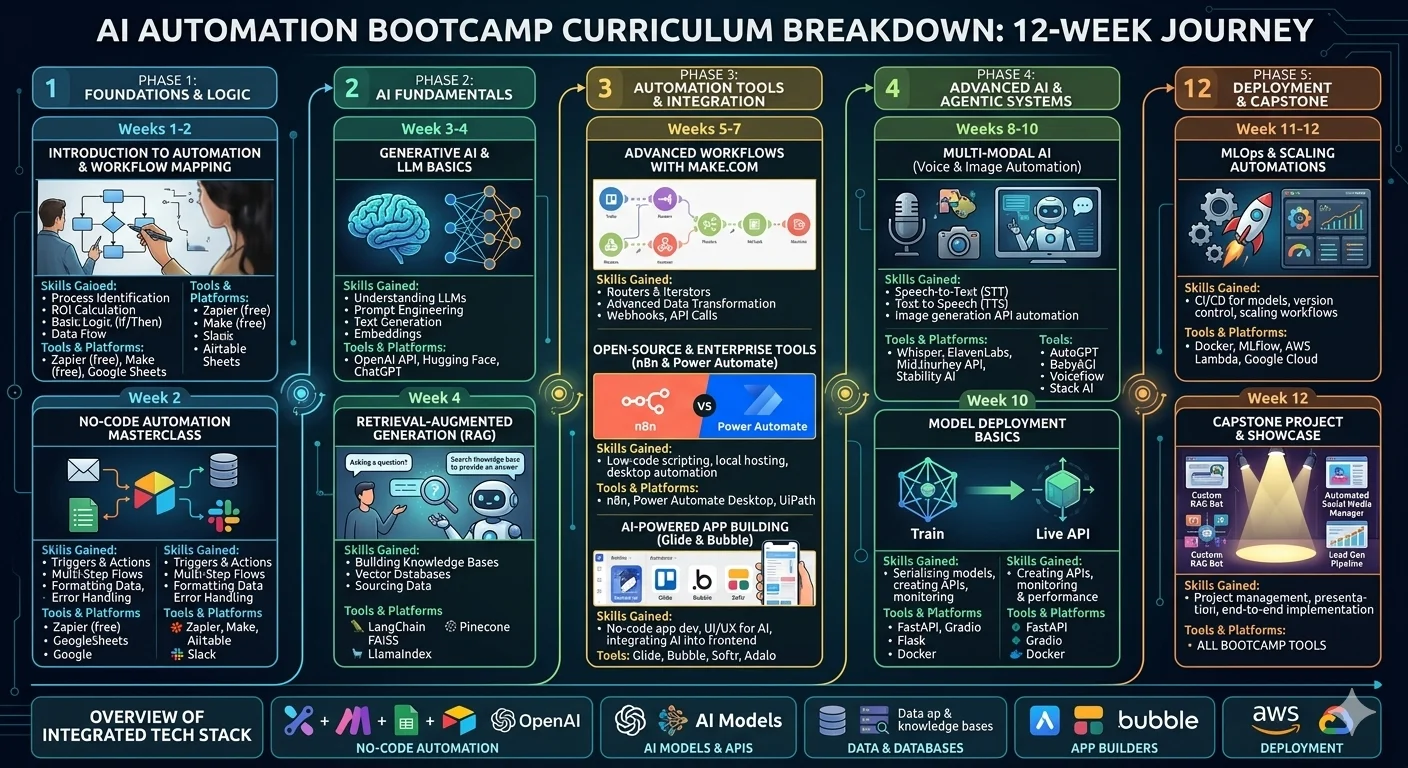
Most bootcamps will start with the basics of automation logic and build their curriculum to AI applications. You will usually be taught on the principles of workflow design, API integration, using conditional logic and data manipulation. Then, programs add on machine learning fundamentals, the use of natural language processing and intelligent document processing.
Tools and Platforms Covered
Hands-on training of platforms like Make (formerly Integromat), Zapier, n8n, LangChain, OpenAI APIs, robotic process automation (RPA) tools like UiPath, and Power Automate. For custom automation and retrieval-augmented generation systems, advanced programs also feature Python scripting and vector databases.
Real-World Projects
Capstone projects are essential for the most effective bootcamps. This can involve the development of AI systems for customer support, AI automation for entire sales processes, or AI-powered data extraction systems that identify information from unstructured documents.
Who Should Enroll in an AI Automation Bootcamp
The programs are appealing to a broad spectrum of professionals. While some bootcamps require a computer science background, it is not essential, although be comfortable with some technical aspects.
Ideal Candidates
Immediate value for business operation managers who need to streamline workflows. Another group of marketers is looking for ways to automate campaign management, reporting, and lead nurturing. Since freelancers and agency owners who wish to create more, while working less are also serve, it is a great deal of benefit.
AI automation can often create completely new career paths in a matter of weeks, for those who are career changers from nearby fields like project management, data entry, or administrative work.
How to Choose the Right AI Automation Bootcamp
The wrong program will be waste of time and money. To make a smart choice, here is a step-by-step guide..
Step 1: Define Your Goal
Consider if you are interesting in incorporating automation into your existing job, changing careers to work in automation, or creating an automation consulting business. Depending on your answer, you will need a program that is easy to learn or a technical program.
Step 2: Evaluate the Curriculum Depth
In step 2, the Curriculum Depth was evaluated. Don’t just skim the marketing pages. Ask for syllabus, look at project samples from previous classes, and determine if the tools learned are available in the industry now. Programs continuing to teach outdated platforms indicate that programs are not being maintained.
Step 3: Check Instructor Credentials
Teachers should have professional experience, not merely academic experience. Search for individuals who are involved in automation agencies, companies with AI implementation teams, open-source automation projects, etc. Real life experience is seamlessly translated to real life teaching.
Step 4: Assess Community and Support
The best bootcamps provide access to an alumni network, a mentorship matchmaking feature, and regular updates to resources for the rest of one’s life. The technology of automation is evolving quickly, and a solid community ensures that your skills remain up-to-date well beyond graduation.
Step 5: Compare Cost Against Outcomes
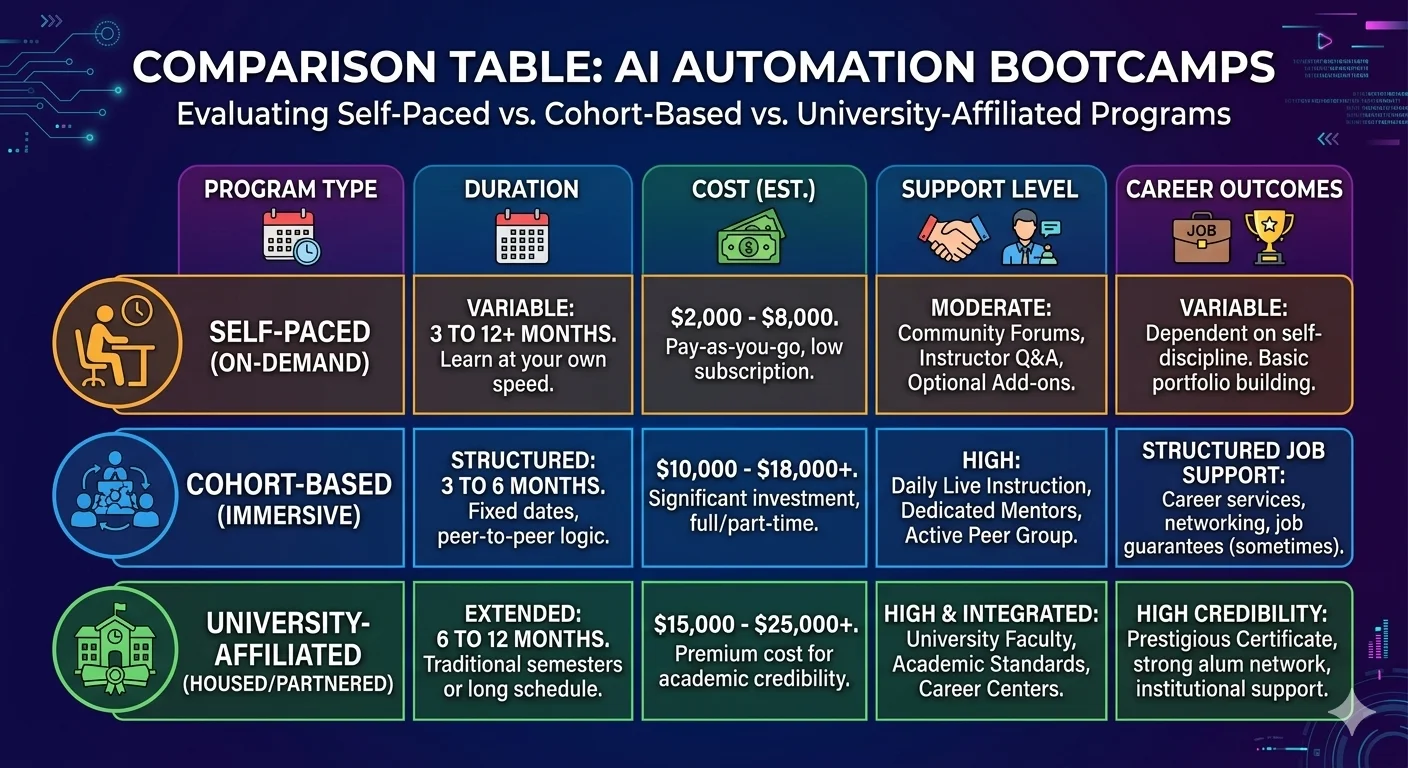
Bootcamp tuition costs vary from a few hundred dollars for self-paced programs to thousands for live, cohort-based bootcamp programs that offer career assistance. Check alumni employment, salary, and portfolio quality to assess ROI.
Career Outcomes After Completing an AI Automation Bootcamp
The graduate is usually promoted to become an automation consultant, AI workflow specialist, business process analyst, or no-code solutions architect. Others develop their own practice around the areas where businesses are actively looking for automation skills.
The salary range for this position can differ based on location and experience, but individuals who have experience with AI automation tend to earn higher salaries than those who don’t. Why is the compounding effect an important one to consider? Because, automation skills are applicable in almost all industry segments.
Building a Portfolio That Gets Hire
Employers and clients want proof. Record all projects you create in bootcamp. Make short demonstration videos. Prepare case studies with before and after data. The success of a single, documented automation that saves the business 20 hours a week is more convincing than any badge by itself.
Common Mistakes to Avoid
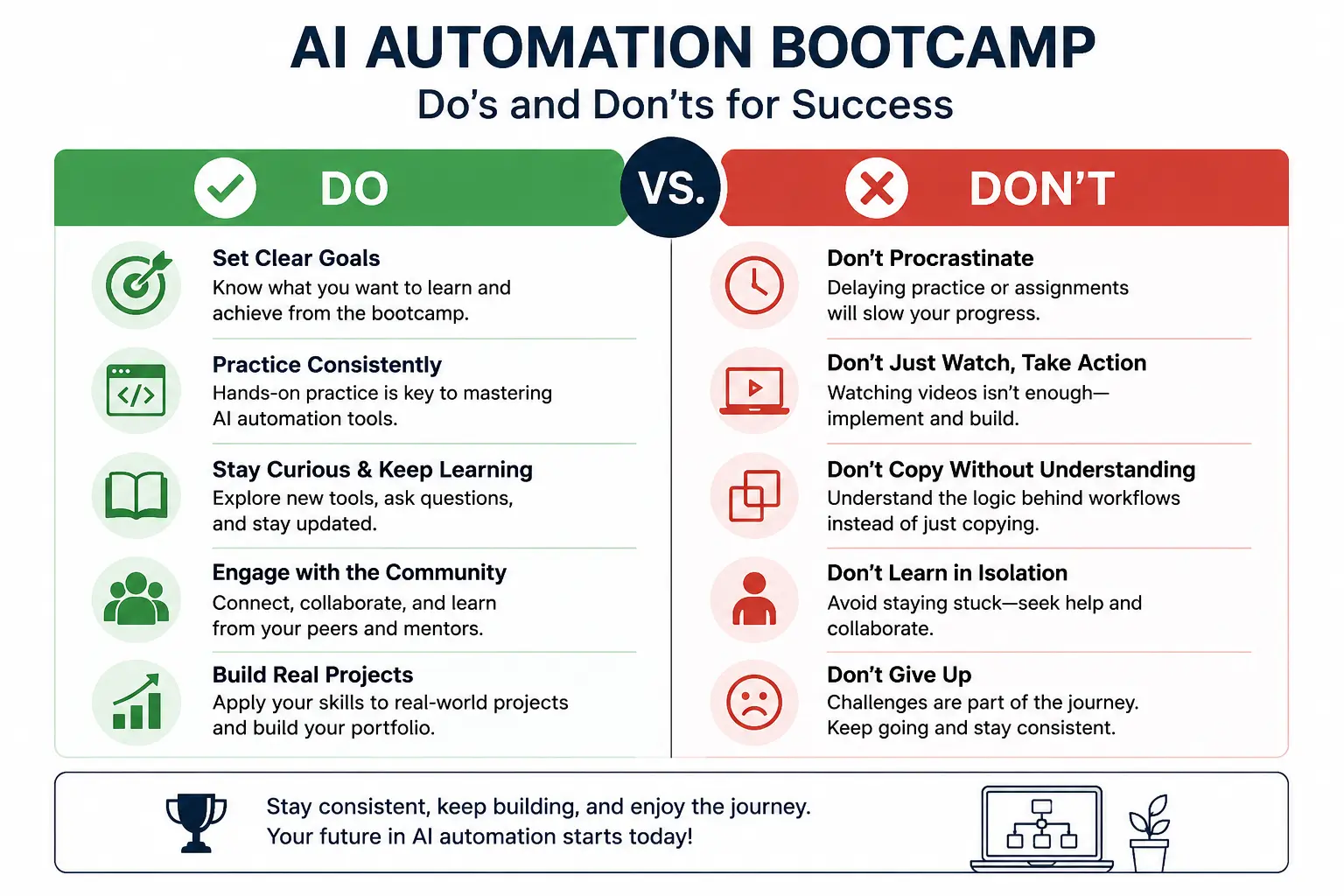
It is no surprise when many students enter an AI automation bootcamp thinking that the learning is passive. It is not. The pros who get the most out of it see it as a business and spend hours a day focused on developing, testing and testing again automated systems.
Another common error is “tool obsession.” Tools change constantly. Principles endure. Learn why, rather than how, automations are configured in a particular way.
Conclusion: Take the First Step Toward Automation Mastery
In today’s era dominated by intelligent systems, one of the most efficient and hands-on methods to ensure your career’s future is an AI automation bootcamp. The skills that you acquire are applicable in various industries, cumulative, and enable you to be a person who is capable of solving costly operational issues.
Never let your company automate you! Make it automatic for them.
Get your research on bootcamp programs today! Research programs, speak to graduates, and make sure it’s the program that meets your career objectives. These are the guys who are automating workflows and creating career paths that others will want to have started earlier.
Frequently Asked Questions
How long does an AI automation bootcamp typically take?
The length of the AI automation bootcamps varies from 4 to 16 weeks, depending on the self-paced or cohort learning model. Content may be packed into a four to six-week intensive full-time program, or a 12- or 16-weeks. Part-time program that meets in the evening and on weekends to accommodate working professionals.
Do I need coding experience to join an AI automation bootcamp?
Many of the bootcamps are geared towards non-technical people, and emphasize applications that rely on no code or low code. Some programs might call for some programming knowledge, however, those that involve Python scripting or API creation. Please check prerequisite(s) prior to registration.
How much does an AI automation bootcamp cost?
The cost of these programs varies greatly, from around $500 to $5,000 and up for live, mentorship-based cohort-based programs with career support services. There are also income share agreements or payment plans available for some platforms to minimize financial barriers to entry.
What jobs can I get after completing an AI automation bootcamp?
Typical career paths for graduates are automation consultant, AI workflow specialist, business process analyst, RPA developer, no-code solutions architect, and freelance automation specialist. Many also apply these skills to their current jobs and receive promotions or lateral transfers to more technical teams.
Is an AI automation bootcamp worth it compared to self-study?
A bootcamp is a more organized and effective learning experience that includes feedback from experts, peer accountability. And project work that is ready for your portfolio that self-study just doesn’t provide. Self-study can help highly disciplined learners, but bootcamps can drastically accelerate your path to competency. And have the added benefit of networking opportunities that can quickly become employment or client opportunities.