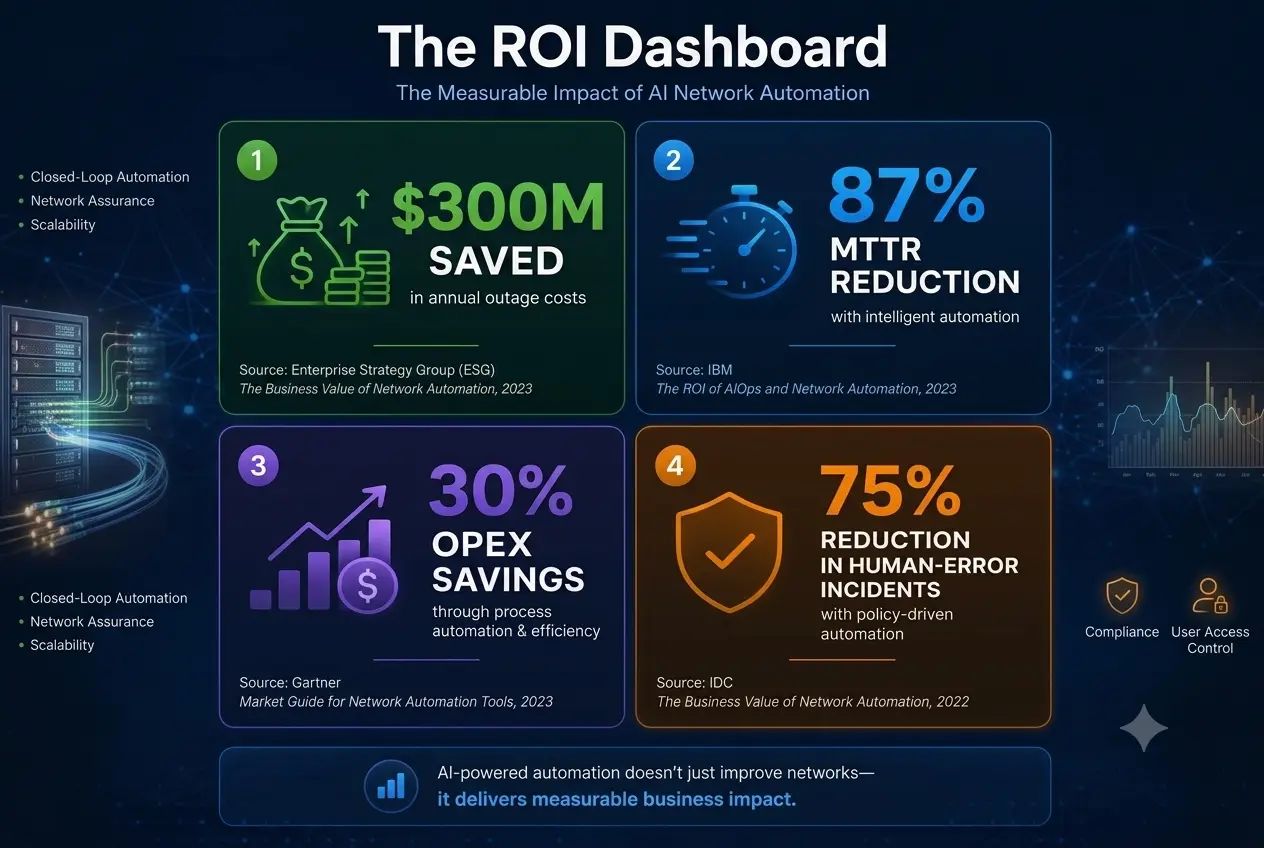
It pays to be up at night as a CTO, as here’s a number that should keep you awake: $9,000 per minute. This is the average loss when networks are down in 2026. Multiply that across the Global 2000, and Splunk’s latest research reveals companies are bleeding $300 million per year to unplanned outages—with 43% of those outages caused by network or IT environment failures.
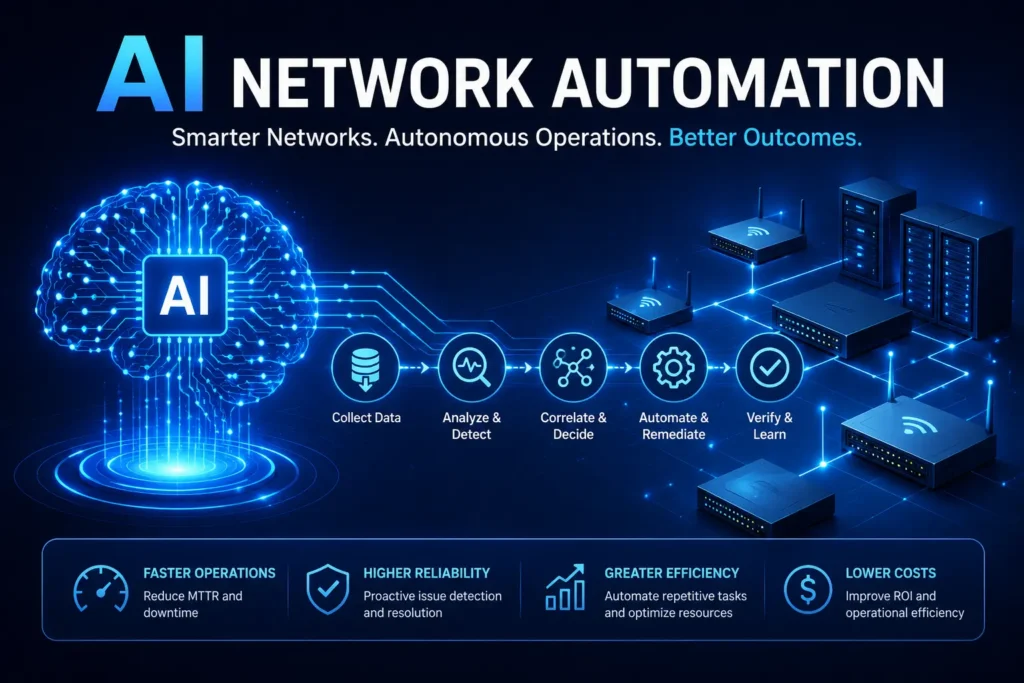
AI network automation is the technology ending this haemorrhage. It uses artificial intelligence and machine learning to monitor, configure, troubleshoot, and self-heal computer networks. Before humans even notice a problem. Organisations deploying AI-driven network operations report MTTR reductions of 40–87%, operational cost savings of 30%, and near-elimination of the human errors responsible for 75% of all network downtime.
This isn’t a future promise.By the end of 2026, 30% of enterprises will automate over half of network activities, up from under 10% in 2023 – Gartner. Gartner forecasts that by the end of 2026, more than half of enterprises’ network activities will be automated, up from under 10% in 2023. Now the question isn’t about adopting AI network automation, but when you can do it before everyone else.
Why Traditional Network Management Is Failing
Networks in modern enterprises are very different from the ones of 10 years ago. The typical company today is running hybrid multi-cloud deployments, thousands of IoT endpoints, dozens of branch offices with SD-WAN deployments and AI workloads requiring more bandwidth than ever before. This complexity is impossible to withstand with manual CLI commands and static scripts.
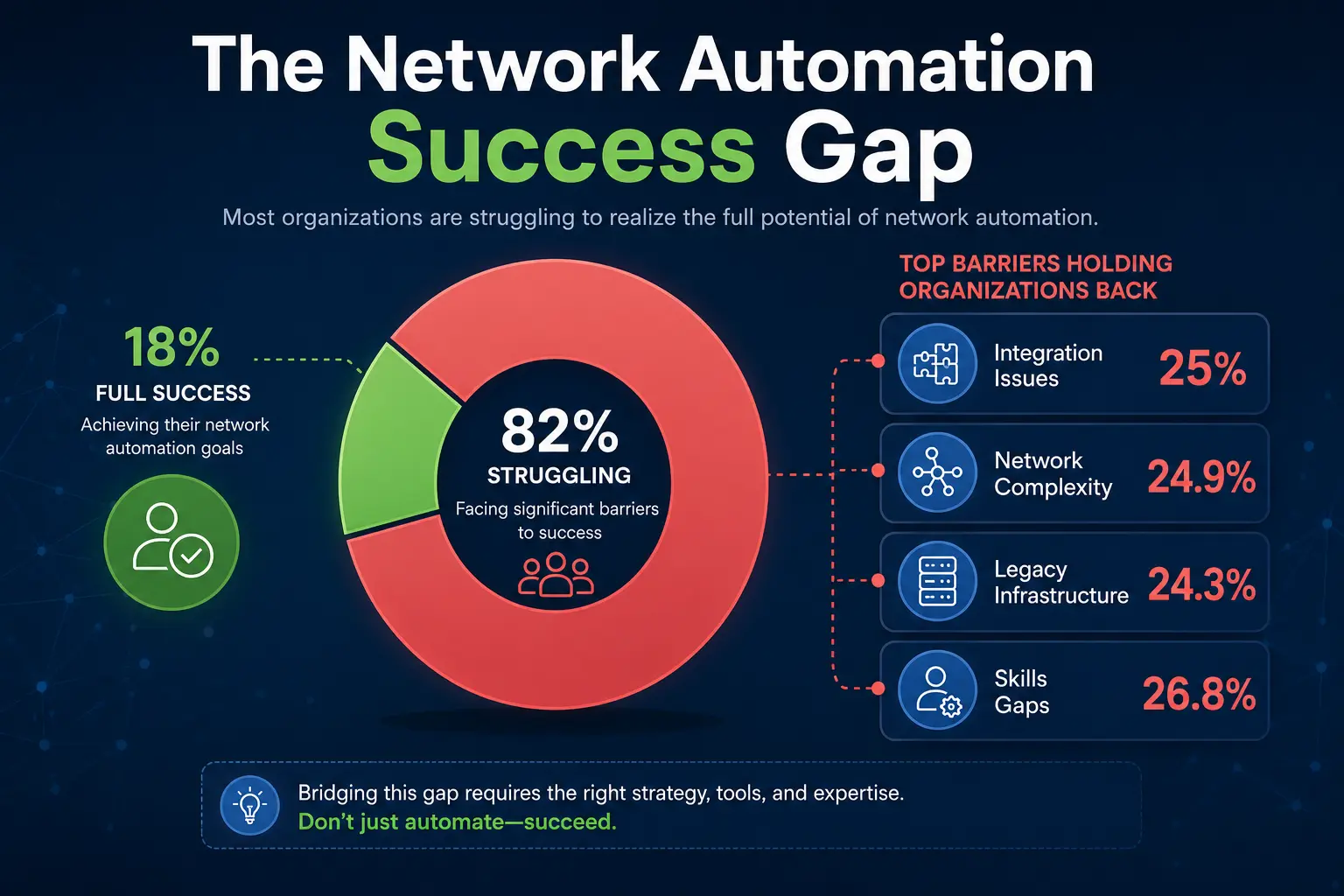
The challenge is confirmed by research from Enterprise Management Associates (EMA): just 18 % of IT professionals say their network automation initiatives are an outright success. A further 54% get some success, and 28% fail to progress or make any progress at all. The usual suspects: integration woes, data that’s spread across many different sources, an inflexible legacy infrastructure without APIs, and a severe lack of skills.
AI network automation fixes all of these problems by adding intelligence, learning and autonomy.
How AI Network Automation Actually Works
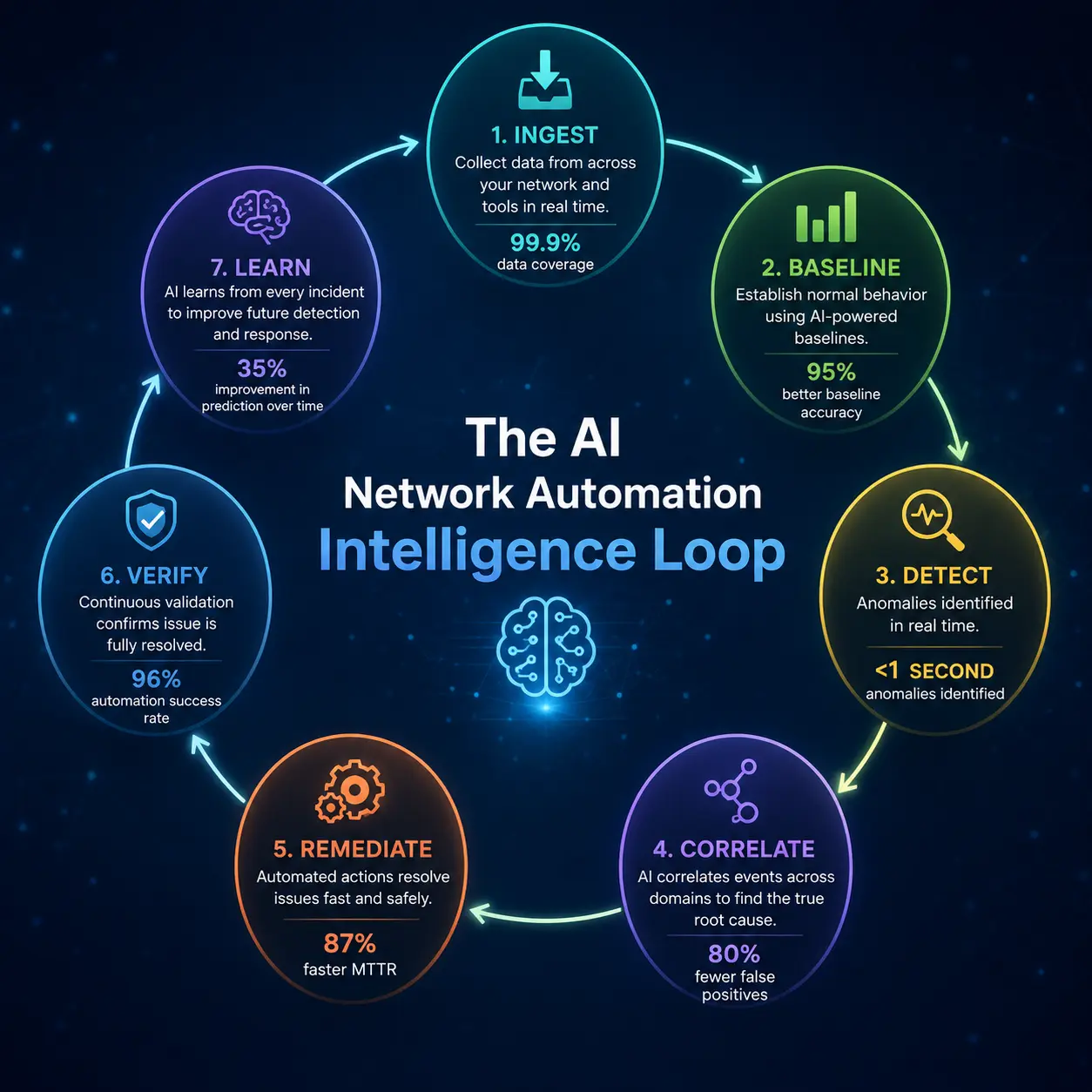
AI network automation is an ongoing intelligence loop that processes data and generates responses based on context, rather than a rule-based response. Each phase is explained and why it is superior to all previous methods.
Real-Time Telemetry Ingestion
These AI platforms consume streaming data in real-time from all routers, switches, firewalls, wireless access points and cloud gateways. Millions of metrics per second: Packet loss ratios, Jitter measures, CPU utilisation, BGP route changes, Security events etc. Modern streaming telemetry is replacing old-school SNMP polling, and provides a “living picture” of network health with sub-second granularity.
Behavioral Baselining and Anomaly Detection
A machine learning model is not a template, it is a model that is built off of real traffic data on your network, the time of day, seasonal data, and application behaviors to define “normal”. If there’s a deviation, whether it’s a latency that gets closer than it should to a critical WAN link, an unexpected traffic surge between east and west in the data center, or a device connecting to an IP address that is not recognized, the AI notices instantly.
Predictive Root Cause Analysis
This is where AI surpasses traditional monitoring. Instead of sending 47 separate alerts for symptoms of the same issue, AI will correlate signals and work out what the root cause is. At MWC 2025, DriveNets showcased this capability by correlating alarms between various parts of a network, uncovering hidden cause-and-effect relationships between them, and identifying root causes that would take human network engineers hours to find, cutting the overall time needed to resolve a network incident by 87%.
Autonomous Remediation and Closed-Loop Action
Upon identifying the root cause, the orchestration engines automatically trigger pre-defined remediation playbooks such as rerouting traffic, configuration rollback, removal of infected devices, augmenting bandwidth or triggering failover procedures. Then the system monitors the result, makes sure that this is the solution that solved the issue, logs the result and returns it to the model to improve it further.
The ROI of AI Network Automation: Numbers That Demand Attention
Let’s get to the business impact. The business case for AI network automation isn’t theoretical – it’s based on hard data from real deployments.
Downtime Costs Eliminated
The average Global 2000 company reported $300 million in annual outage costs; and following a large scale service disruption the stock price dropped 3.4%, resulting in years of return on investment from the automation investments made. The AI functionality of predictive maintenance identifies failures before they affect production and turns unplanned downtime into planned maintenance windows.
Operational Efficiency Gains
EMA’s research found that 33.9% of organizations achieving automation success cite operational efficiency as the primary benefit—skilled engineers become dramatically more productive when freed from repetitive configuration tasks. A Fortune 500 retailer in the EMA study reported that automating simple device commands across thousands of locations transformed what was previously “a huge job” into one-click operations.
Security Risk Reduction
Reduced security risk is cited as the second benefit, 32.8%. The AI-driven tools will do away with the configuration errors that leave systems vulnerable. While the AI-based behavioral analytics will identify threats that are not picked up by signature-based tools at all.
MTTR Collapse
Enterprise organizations using AI-driven observability report MTTR reductions of 40–60% on average, with leading implementations like DriveNets achieving 87% reduction. Telia’s collaboration with tmforum found that automating incident correlation accelerates problem detection by up to 90%.
What AI Network Automation Means for Network Engineers
Asking the question, will AI automation take the place of network engineering roles?
EMA’s interviews with IT leaders definitively answer no. “Automation takes human error out of the network. We’ve decreased outages by a significant amount,” reported a network automation engineer at a large university. “We’ve empowered technicians who lack the skillsets to make changes and write configs. Field teams can be made up of people with lower skillsets, who can go out and hit a button to troubleshoot things.”
AI network automation takes engineers from task execution to architecture, policy design and innovation. Skill sets evolve towards API use, fundamentals of Python, basic data analysis and knowledge of automation frameworks, while the need for networking skills expands – not decreases – as networks grow more complex.
Top AI Network Automation Platforms to Evaluate
The platform landscape has matured significantly. Cisco’s AI Network Analytics embeds machine learning within DNA Center and Catalyst Center for campus and branch environments. Juniper Mist AI delivers cloud-native wireless optimization with proactive anomaly detection. Itential provides vendor-agnostic orchestration that bridges AI insights with governed, compliance-driven workflows—critical for enterprises running multi-vendor environments. The 87% MTTR reduction achieved at MWC 2025 proves DriveNets’ carrier-grade AIOps. Ansible and Terraform are still the backbone of configuration automation, now enhanced by AI layers for intelligent decision-making.
The best one to use is based on your vendor landscape, size, and level of automation. Many successful organisations take a composable route, using dedicated tools through API connections and not relying on one vendor.
Conclusion
AI network automation has crossed the threshold from promising technology to operational necessity. Network downtime is projected to cost $9,000 per minute, human errors are responsible for 75% of outages, and Gartner predicts that 75% of enterprises will adopt some level of automation by 2026. And the organizations that do now benefit in a compounding way from reliability, security and cost effects. Implementation is straightforward, the tools are proven and the ROI is proven. Everything else is up to your organization’s speed.
FAQs
1. What is AI network automation, and how is it different from traditional automation?
Traditional network automation runs pre-programmed scripts and static workflows, which do exactly what you tell them, no matter what context. AI network automation brings in machine learning intelligence that learns the behavior of the network, anticipates information failures, derives root causes in correlated information incidents, and dynamically adjusts responses based on network behavior. It’s between the difference of a thermostat that follows the clock and one that learns and adjusts proactively.
2. How much can AI network automation reduce downtime costs?
The MTTR reduction in deployments ranges from 40% to 87% (based on maturity level). Average downtime costs are $9,000 per minute (Ponemon Institute). And Global 2000 companies have a $300 million annual loss due to incident downtime (Splunk 2026), which means millions of lost revenues and productivity even with a 50% reduction in incident duration.
3. What are the biggest barriers to implementing AI network automation?
EMA research shows that the top integration challenges with existing systems (25.4%). Network complexity and lack of standards (24.9%), skills gaps in the workforce (26.8%). And lack of a unified data source of truth (22.3%) are the biggest challenges when it comes to APIs. The key to success is to get the data quality and standardisation right.
4. Which industries benefit most from AI network automation?
All industries with network-based processes gain, with the greatest ROI coming from telecommunications, financial services, healthcare, retail and manufacturing. In a multi-vendor environment, with massive infrastructure managed by the Telcos, AI correlation is vital. Downtime is unacceptable in the financial services sector. Reliable connectivity is needed for life critical systems in healthcare. Centralized AI-driven management can provide retail chains with significant efficiency and streamline thousands of stores.
5. Do I need a large IT team to implement AI network automation?
No. Cloud managed platforms such as Juniper Mist AI and Cisco Meraki bring AI based insights and automation as a service, with little on-premises expertise needed. Itential’s low-code orchestration platforms are designed to allow network engineers to create automation processes without needing to learn programming in depth. It’s not about how many people you have in your team. It’s about the level of data standardization and trust in automation that occurs in every stage of the process.