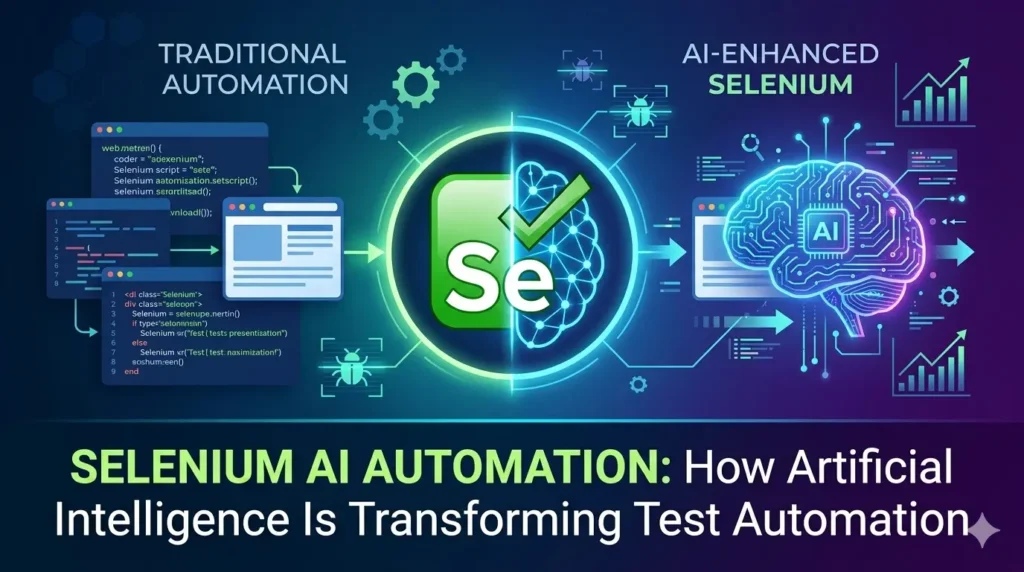
Selenium AI automation is the AI-enhanced version of the world’s most popular browser automation framework. Making test automation faster, smarter and more resilient. Teams can cut test maintenance by up to 75%, avoid flaky test failures and speed up release cycles significantly by adding self-healing locators. Intelligent test generation and visual regression detection features to their AI. As a QA engineer, developer or engineering leader. You’ll learn exactly how selenium AI automation works. The various tools they have, and how to work through the process step-by-step.
What Is Selenium AI Automation?
Selenium has been the backbone of web test automation since 2004. Can be used to write scripts to perform actions on browsers, simulate human interactions like clicking buttons, filling forms, etc. And navigating between pages. However, the problems with Selenium testing are that the locators are fragile, they need to be maintained with every UI iteration, and that tests can be flaky, destroying your confidence.
The Selenium AI automation overcomes these challenges by adding artificial intelligence to the existing Selenium automation frameworks. Rather than using static hard-coded locators and manually-written scripts, AI-based tools learn from historical test data. Analyse the application behavior and adjust accordingly to changes in your application’s interface.
The outcome is a less human-intensive testing process that captures more defects and doesn’t fall behind the latest continuous delivery pipelines that are pushing multiple releases per week.
Why Traditional Selenium Testing Needs AI
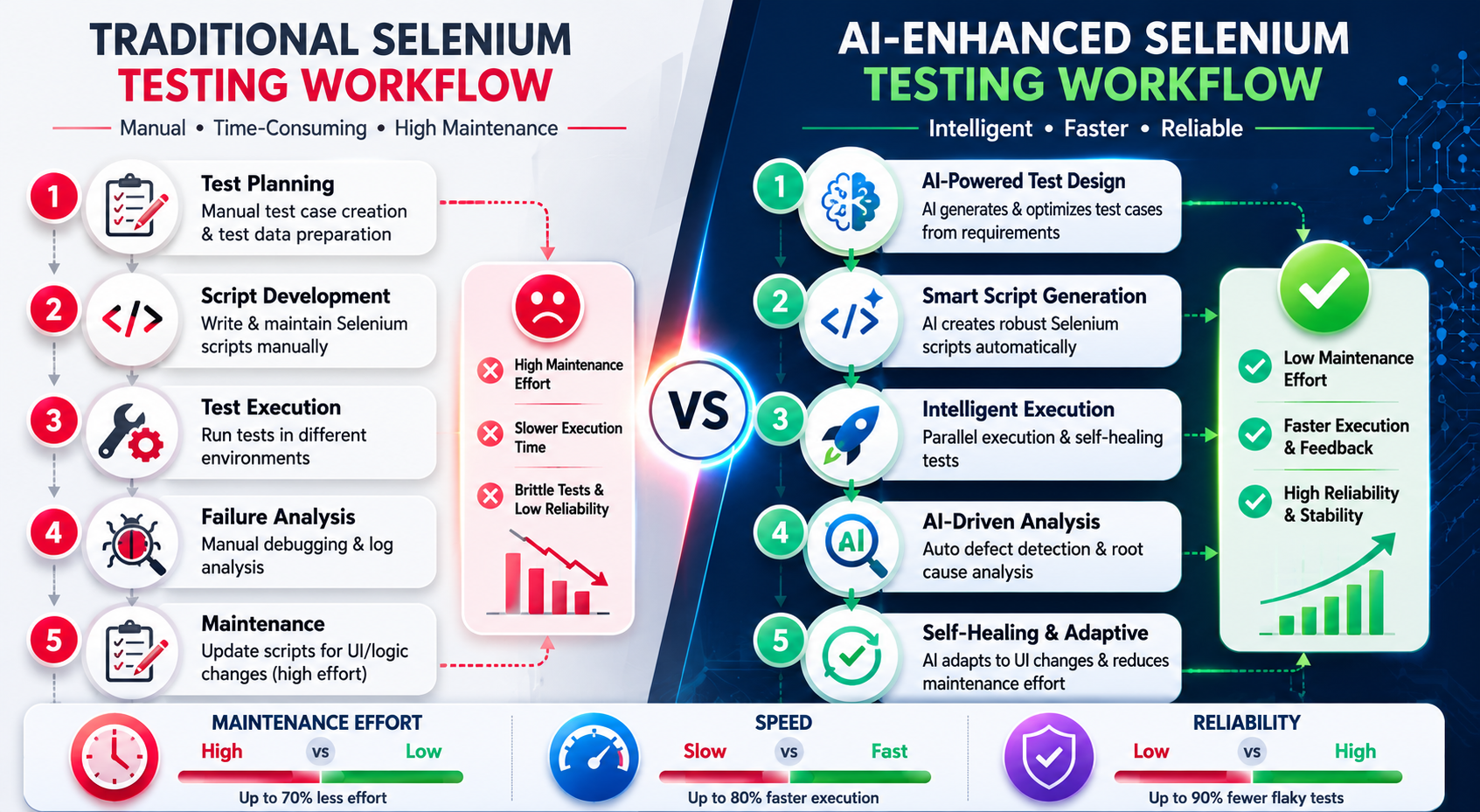
Modern software teams face a reality that Selenium alone was never designed to handle. Applications update frequently, user interfaces shift constantly, and engineering teams are smaller than ever. The challenges of pure Selenium automation have become increasingly apparent.
First, locator brittleness is a persistent problem. Selenium tests rely on XPath or CSS selectors tied to specific attributes within the DOM. When a developer renames a class, adds an HTML wrapper, or restructures a component, dozens of tests can fail simultaneously. Not because of actual bugs, but because the locators no longer match.
Secondly, test maintenance is a vast amount of engineering time. Research indicates that QA teams invest up to 60% of their effort in maintaining current tests, instead of adding new coverage. This ratio is not realistic for fast moving development environments.
Third, flaky tests are an industry-wide pain point. Tests that pass sometimes and fail other times — often due to timing issues, network delays, or dynamic content — undermine trust in the entire test suite and slow down CI/CD pipelines.
AI addresses each of these challenges directly, making Selenium not just functional, but genuinely intelligent.
How AI Enhances Selenium Automation
AI-Powered Test Generation
One of the most transformative applications of Selenium AI automation is automated test creation. You can use AI tools to automatically create comprehensive test cases from the structure. User stories and past usage patterns of your application, instead of having to write each test script manually.
Generative AI analyzes app behavior and requirements to generate Selenium compatible scripts that capture user workflows that are important. There are some platforms where you can input test scenarios in simple English and translate those scenarios into an executable automation code using AI. This has a massive impact on the difficulty of creating a test, and can enable a wider range of people in the team, including product managers, to participate in testing.
Platforms such as BrowserStack Low Code Automation and Testsigma can make this possible by providing AI-powered interfaces that act as a wrapper around Selenium’s core engine to take natural language instructions.
Self-Healing Locators
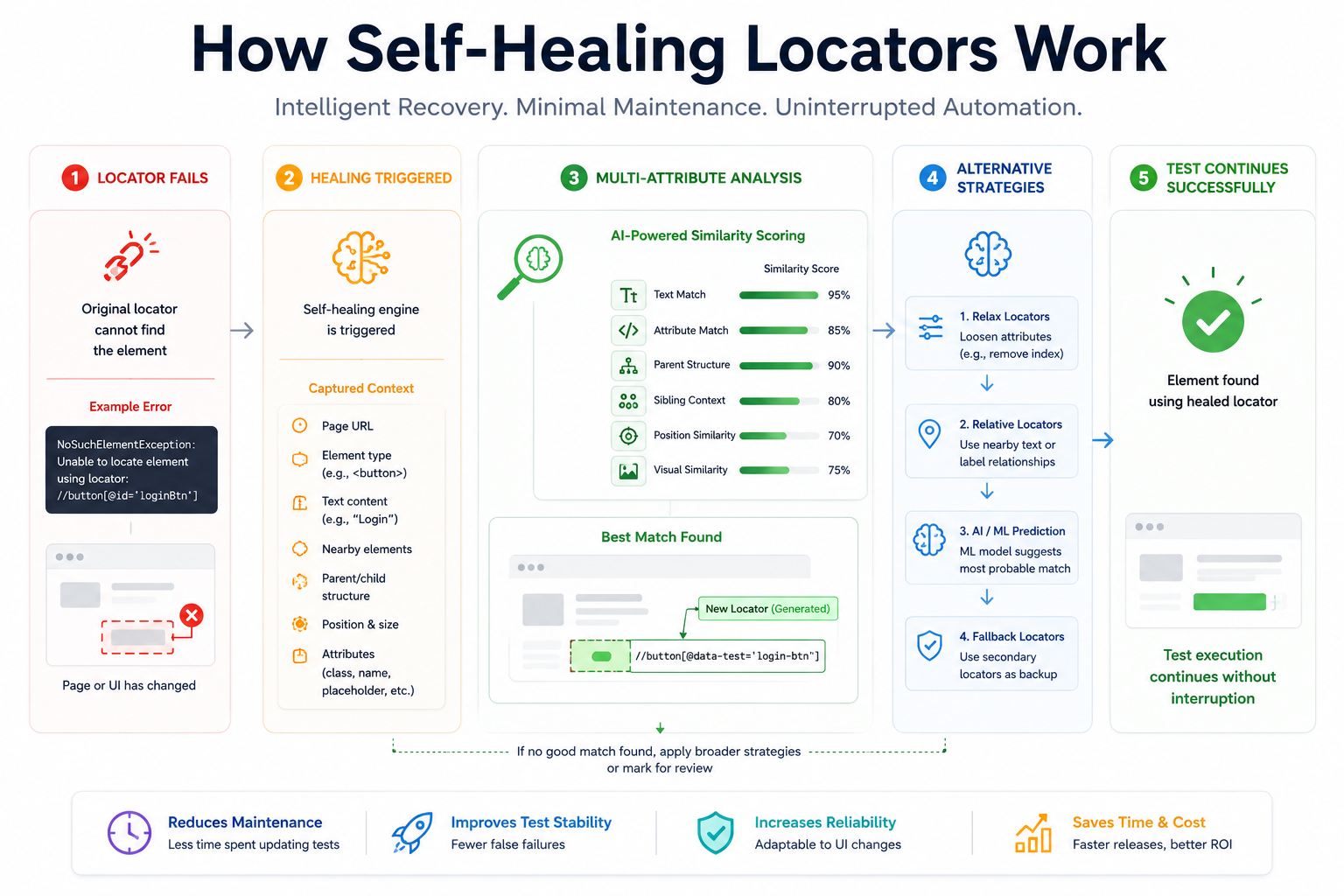
Perhaps the most obvious advantage Selenium users might have from AI is self-healing. If a locator fails to return because of a UI change, the self-healing mechanism automatically detects another method for identifying the element, thanks to the AI.
The process takes place in several layers. Not only one identifier, but a fingerprint of the element based on its text content, visual position, neighbors and HTML hierarchy is analyzed by the AI. In case the main locator fails, it automatically implements backup techniques, comparing the visual pattern as well as the text content or DOM structure to find the right element.
Over time, the system learns how elements evolve within your application. A button labeled “Submit” that becomes “Confirm” but retains the same functional position will still be recognized. This historical learning means your tests become more resilient with every run.
Visual AI for UI Validation
Selenium traditionally validates functionality through the DOM. If the HTML structure looks correct, the test passes — even if the visual rendering is broken. A button might be hidden behind another element, text might overflow its container, or colors might render incorrectly after a CSS change.
However, Visual AI fills this void by comparing real screen shots with baseline images. Modern visual AI can comprehend semantic differences, unlike simple pixel on pixel matching. It acknowledges that slight deviations in spacing are benign, but anything that is out of place with regard to the text or cropped images are actual step backward. It also cleverly filters out dynamically changing content such as rotating ads, personalized dashboards or timestamps, which vary between test runs.
Screenshots capture tools, like Applitools Eyes and BrowserStack Percy, integrate seamlessly with Selenium via lightweight SDKs and perform intelligent comparisons across full browser and device types, all at the same time.
Intelligent Flaky Test Management
AI tackles flaky tests through multiple strategies. Automated defect triaging analyzes failure patterns and categorizes them based on error type, affected components, and historical data. This helps teams instantly distinguish between genuine bugs and environmental noise.
AI-powered tools also detect unstable conditions — pages that haven’t fully loaded, delayed network requests, or server-side rendering delays — and automatically apply adaptive waits or smart retries. Failure grouping clusters similar issues together so that a single root cause doesn’t generate dozens of redundant tickets. Deduplication compares failure messages to eliminate duplicate bug reports automatically.
Intelligent Flaky Test Management
AI tackles flaky tests through multiple strategies. Automated defect triaging analyzes failure patterns and categorizes them based on error type, affected components, and historical data. This helps teams instantly distinguish between genuine bugs and environmental noise.
AI-powered tools also detect unstable conditions — pages that haven’t fully loaded, delayed network requests, or server-side rendering delays — and automatically apply adaptive waits or smart retries. Failure grouping clusters similar issues together so that a single root cause doesn’t generate dozens of redundant tickets. Deduplication compares failure messages to eliminate duplicate bug reports automatically.
Top AI Tools for Selenium Automation in 2025
Multiple platforms are available that can improve the capabilities of Selenium with AI.There are several platforms that stand out for their potential to improve the capabilities of Selenium with AI. AI features like self-healing locators, visual testing using Percy, and intelligent test analytics on more than 3,000 real browsers and devices augment BrowserStack’s cloud-based testing platform.
Using an agentic approach, Testsigma has specific AI-powered agents such as Generator, Runner, Analyzer, Healer and Optimizer, created to automate each phase of the testing lifecycle. Can take tests in plain English or code and automatically translate to Selenium commands.
Testim’s Smart Locators technology is a big advantage when it comes to managing locators: It detects a full fingerprint of an element and automatically adapts locators if the interface changes. Applitools focuses on visual AI through its Eyes product, comparing rendered screenshots with intelligent baseline management and integration across the Ultrafast Grid rendering engine.
Parasoft Selenic specifically targets existing Selenium Java projects, providing AI-powered recommendations for more stable locators and automatic test repair without requiring migration to a new platform.
Best Practices for Selenium AI Automation Success
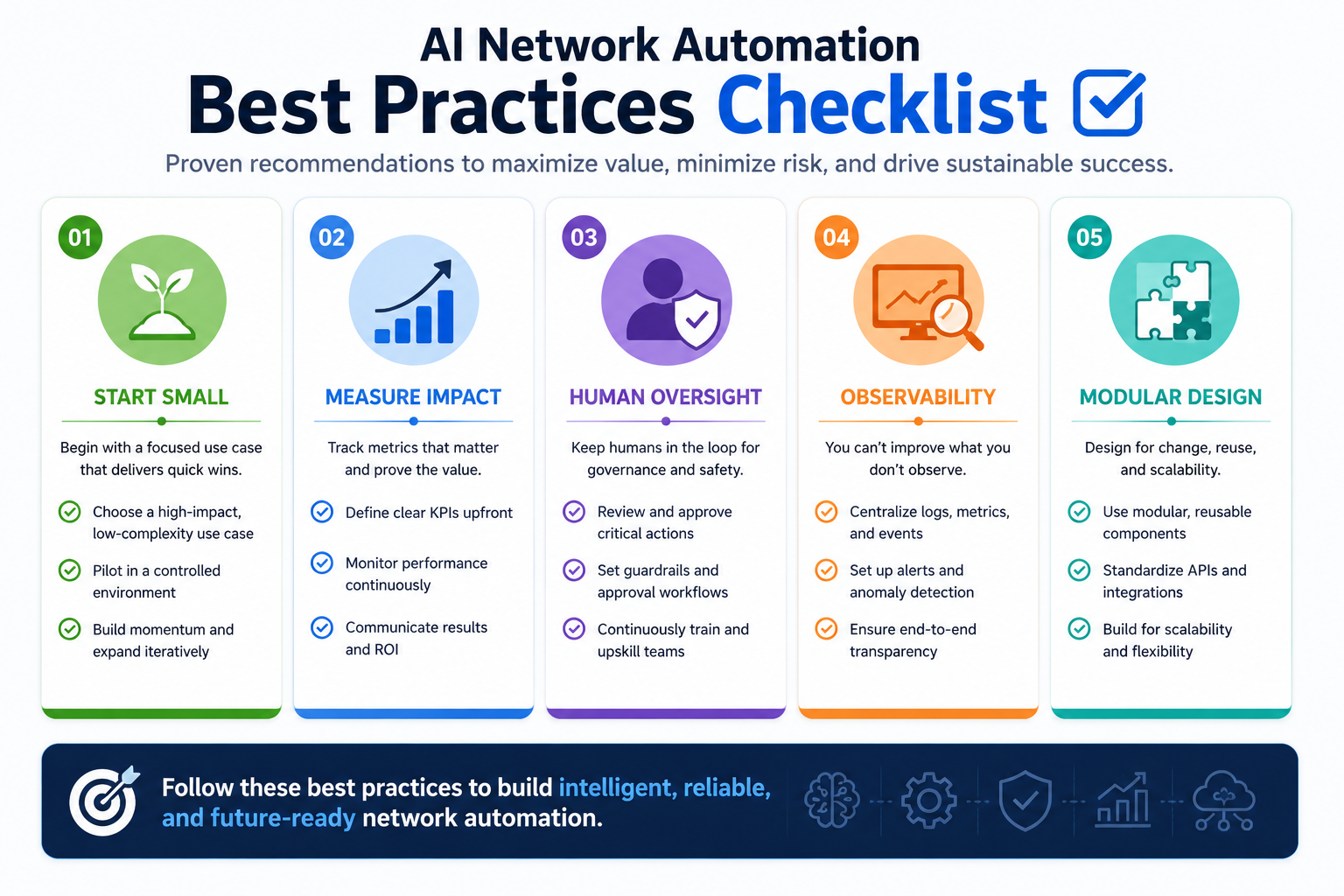
Successful implementation requires a measured approach. Start with one specific problem rather than trying to apply AI everywhere simultaneously. Measure concrete outcomes like maintenance time saved or false failure rates eliminated. Ensure that humans are involved in making decisions when it matters: AI can speed up and repeat tasks, while human decision-making can verify accuracy and uphold quality control.
Keep things visible and trackable, with an observation of every AI action being recorded and available for tracking. Use guardrails to limit AI agents’ environment and permissions. Develop a modular test design where AI logic can be isolated from main test scripts, allowing for easy tool swaps and/or changes in strategy without rewriting your entire test suite.
Conclusion
Selenium AI automation is the next logical step in the evolution of web testing. The powerful browser automation capabilities of Selenium and artificial intelligence that can alleviate maintenance pain, minimize flakiness, and speed up release cycles. Teams using these tools report 75% reduction in maintenance costs. And many report a dramatic increase in defect detection rates. Even a significant increase in the speed at which they can write tests.
The technology is well tested, the tools are ready, and the advantage of quicker and more reliable releases is too great to ignore. When your team continues to face brittle locators, flaky tests, or rising maintenance expenses. It’s time to embrace the power of AI within your Selenium workflow. Begin with a small test and measure the results and scale up from there. It’s a key factor in what you’re able to achieve in your future releases.
FAQs About Selenium AI Automation
What is selenium AI automation and how does it work?
The Selenium AI automation project aims to bring artificial intelligence functionality into the Selenium browser automation project. API analyzes your application interface, learns element patterns, creates test scripts from natural language element descriptions and automatically fixes broken locators when UI changes. This will enable a self-maintaining test suite that will evolve with applications without the need for constant manual effort.
Is it possible to use AI for current Selenium test code?
Yes. The reason being is that most of the AI-powered tools are meant to complement the existing selenium implementation, not replace it. A framework like Parasoft Selenic, Testim, and Applitools Eyes can be integrated through SDKs or plugins, which do not necessitate total migration. AI capabilities such as self-healing locators can be leveraged from the start and without any changes to an existing test architecture.
What are self-healing locators in Selenium AI automation?
Self-healing locators detect web elements based on several attributes at once, such as text content, visual position, HTML hierarchy and neighboring elements, using machine learning. If a locator fails to work for a UI change, the AI automatically locates the element using other strategies and updates the locator. This removes the most common reason for failures on Selenium tests and drastically decreases maintenance work.
Is Selenium still relevant in 2025 with AI testing tools available?
Selenium is still relevant and popular, especially if augmented with artificial intelligence. There are newer frameworks available, but Selenium’s large user community, comprehensive documentation and wide language support are a solid starting point. While not replacing Selenium, most teams will benefit from pairing the trusted power of Selenium’s automation engine with AI’s healing, generation, and visual validation capabilities.
How much can selenium AI automation reduce test maintenance time?
The average reduction in maintenance time for organizations that have adopted AI-powered Selenium testing is around 50% to 80%. Using only self-healing locators to eliminate most of the test failures due to the constant changes in the UI. In addition to the AI-generated test scripts, intelligent flaky test management frees up engineering time traditionally used on repetitive maintenance activities to allow teams to focus on growing test coverage and delivering features at a faster pace.