The insurance industry has always been paperwork-heavy by design. Every claim carries policy details, police reports, medical records, photos, witness statements. And for decades, a human being had to touch every one of those documents before a single cent moved. That’s changing faster than most people outside the industry realise.
Claims automation isn’t a futuristic concept anymore. It’s a live operational reality at major carriers, and the gap between early adopters and those still running on legacy systems is already measurable in dollars and customer satisfaction scores.
What Claims Automation Actually Means
In simpler terms, claims automation is the process of automating a portion of the claims process using a technology combination of artificial intelligence (AI), robotic process automation (RPA), machine learning, and integrated data systems.
That’s important, because many people equate automation with “replacing adjusters. Well, it’s not exactly correct. The real scenario is: Automation performs the routine, repetitive, data-driven tasks, while the skilled adjusters focus on tasks that require human decision-making.
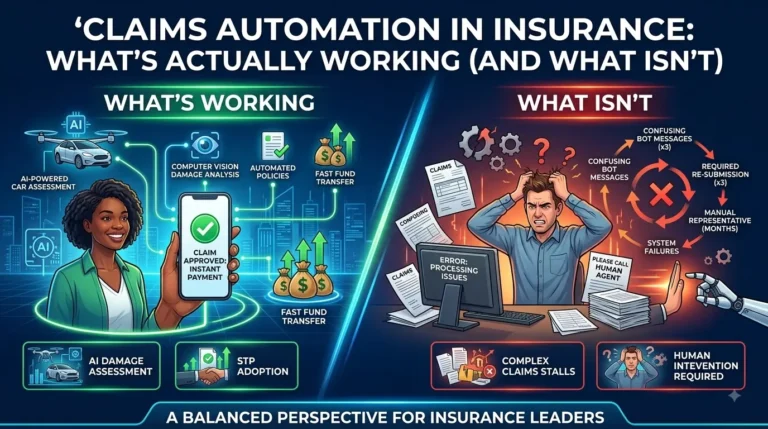
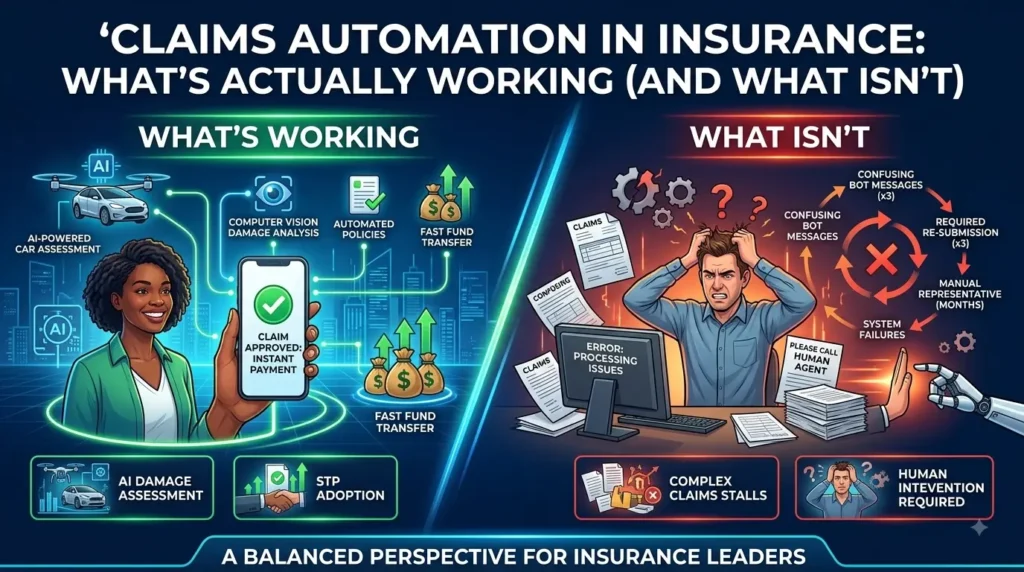
Consider a basic claim to cover contents of a house due to a burglary. The insured submits photos, a police reference number, and a list of stolen items through an app. An automated system can cross-check the policy, verify coverage, apply the deductible, and issue a payment — all without a human touching the file. That same adjuster’s time is then freed up for a disputed liability claim involving three vehicles and a commercial driver.
The State of the Market Right Now
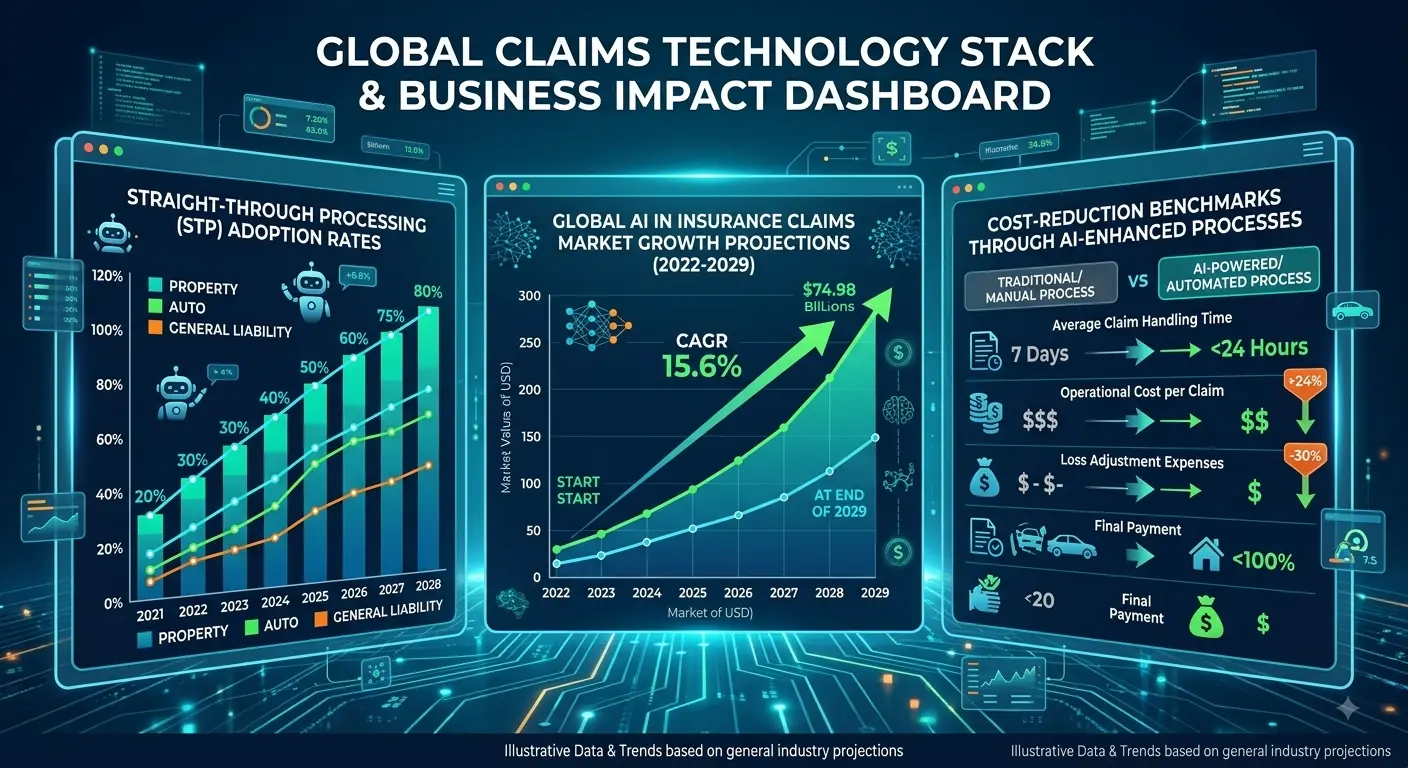
The figures clearly indicate the direction in which the industry is moving.
According to McKinsey analysis, more than half of claims processing tasks can be automated by 2030 with simple claims service through straight-through processing (STP) a standard practice by that time. In 2024, the global AI-for-insurance market was valued at $7.7 billion and is expect to surpass $10.3 billion by 2025, with growth of approximately $33% per year.
The actual outcomes are as spectacular as they come. UK insurer Aviva used more than 80 AI models in its claims processes, and reduced the time to assess claims in complex cases by 23 days. The rate of getting customers to the right teams increased by 30% and customer complaints decreased by 65%. The company claims motor claims automation saved over £60m just in 2024.
Still, context matters. Yet, with all this investment – less than 7% of claims are processed entirely straight through without manual effort in traditional rules based systems. The gap between ambition and reality is still substantial — and worth understanding before committing budget to any automation programme.
How the Claims Automation Process Works
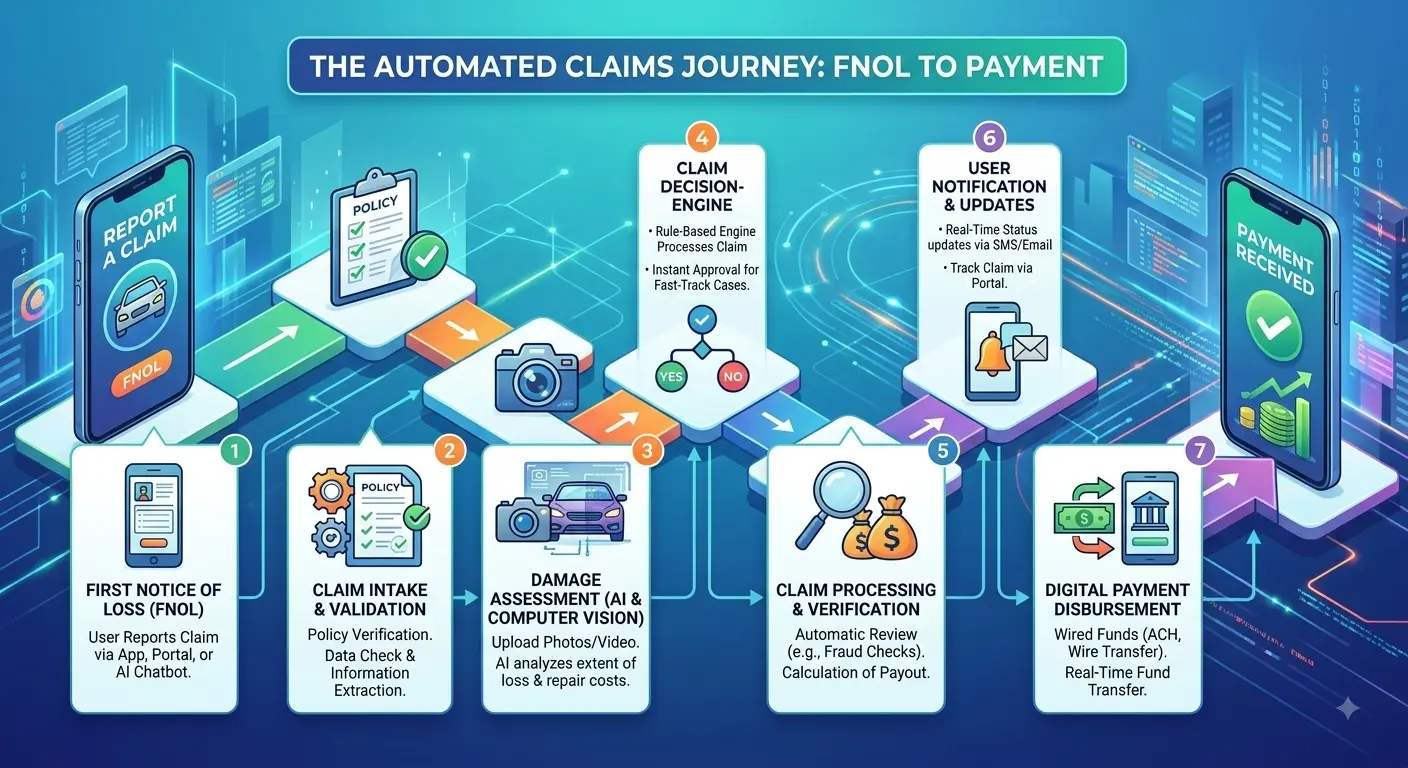
Step 1: First Notice of Loss (FNOL)
he automation journey starts the moment a claim is reported.. Structures data from mobile applications, chatbots, web portals and even voice calls are captured in modern systems. A voice message, a scanned handwritten note are all examples of unstructured input that can be converted to structured claim records using AI-driven intake tools that can be processed automatically.
Step 2: Document Ingestion and Verification
This is where legacy systems typically break down. Traditional Rules-Based Automation has a problem with insurance data that is unstructured: doctors’ notes, police reports, repair estimates in different formats. Now, these documents can be read, interpreted, and validated by AI and optical character recognition (OCR) much more reliably than they were three years ago.
Step 3: Coverage Verification and Triage
The system pulls the policy record, confirms coverage applies, and scores the claim for complexity. Low-complexity claims — minor property damage, standard auto repairs — get routed for automated settlement. Higher-complexity or higher-value claims get flagged for adjuster review, often with an AI-generated summary already prepared.
Step 4: Fraud Scoring
Every claim runs through fraud detection models simultaneously. These systems analyse patterns across thousands of data points — claim history, location data, timing, third-party reports — and produce a risk score. AI detection methods have demonstrated around 28% better fraud detection rates compared to traditional rule-based approaches.
Step 5: Settlement and Payment
For approved automated claims, payment instructions are generated and executed. Leading insurers now resolve simple claims within hours or even minutes. For more complex files, automated systems prepare the claim summary and supporting documentation for the adjuster, reducing their prep time significantly.
Where Automation Genuinely Helps
Speed, at Scale
Manual claims processing is slow and inconsistent. An experienced adjuster handling 150–200 open files simultaneously will inevitably be slower on some than others. Automated systems don’t have bad days. AI-powered photo estimation tools now deliver damage assessments within 24 hours for approximately 78% of claims — compared to the 5–7 days typical of traditional physical inspections.
Cost Reduction
Automation can reduce claims processing costs significantly. Claims processing automation has been reported to slash settlement times by up to 70% in some operational deployments. Lower administrative overhead translates directly to improved loss ratios — which is, ultimately, how insurers are measured.
Fraud Detection
This is one of the strongest genuine use cases for automation. Insurance fraud costs the US alone an estimated $40 billion annually (FBI estimates), with healthcare fraud accounting for a disproportionate share. ML-based fraud scoring screens every claim at the point of intake — something no human team can replicate at volume.
The Limitations Nobody Talks About Enough
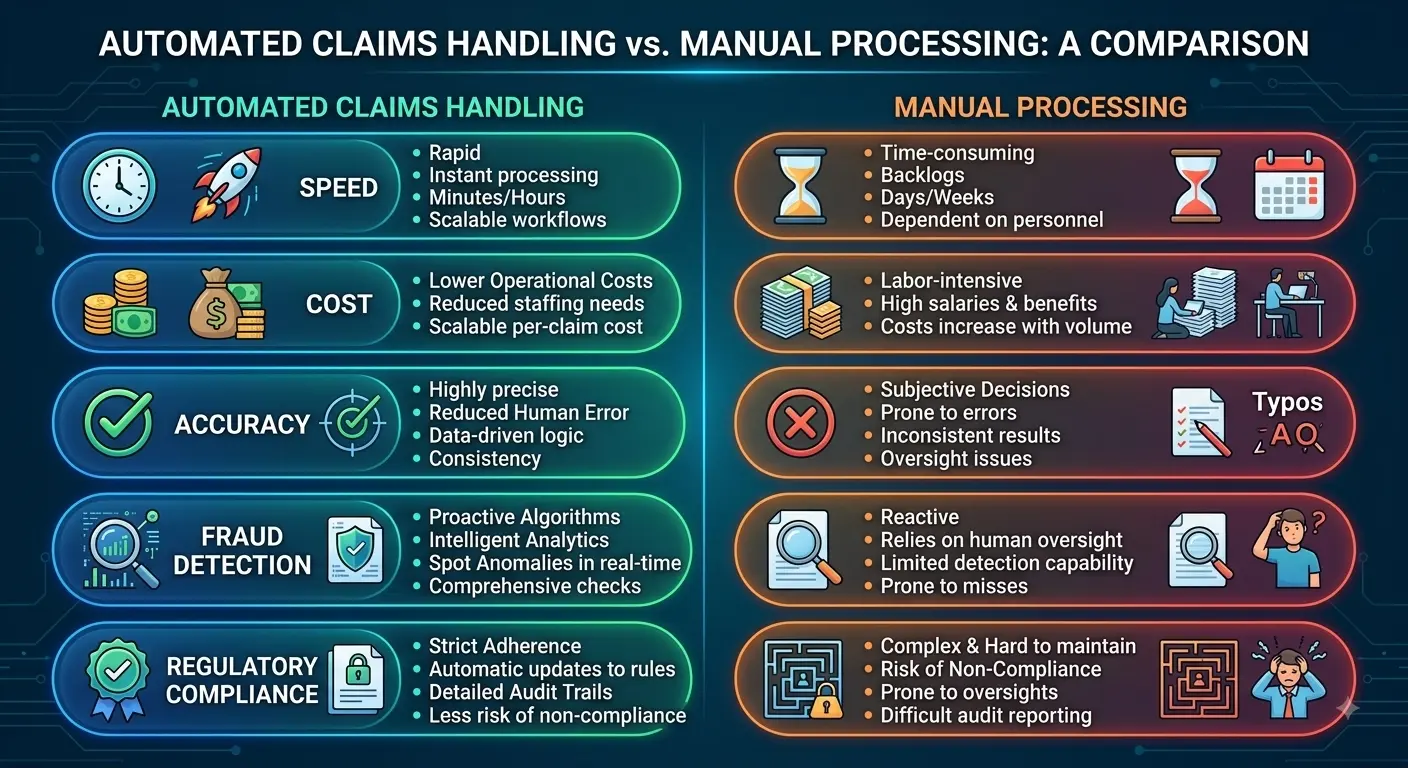
Here’s where some honesty is needed.
The 7% straight-through processing rate cited earlier isn’t a failure of effort — it reflects the genuine complexity of insurance data. Most claims data is unstructured. Systems that work elegantly on standard motor claims can stumble badly on anything with a medical component, a liability dispute, or an unusual policy endorsement.
Regulatory compliance adds another layer of difficulty. Every automated decision needs a defensible audit trail. In jurisdictions with strict claims handling regulations — the UK’s FCA, the US state insurance commissioners — insurers can’t simply automate a decision and move on. The decision logic needs to be explainable, documented, and reviewable.
Legacy system integration is arguably the biggest practical barrier. Most major insurers run core policy administration systems that are decades old. Connecting modern AI tools to those systems is expensive, time-consuming, and occasionally produces unpredictable results during the transition period.
There’s also a customer experience risk that often gets overlooked. Automated systems, if poorly calibrated, can generate a wave of incorrect decisions that feel worse to policyholders than a slower but accurate manual process. A customer who gets an incorrect automated denial and then has to fight through an appeals process hasn’t been served by automation — they’ve been let down by it.
Early adopters achieving STP rates of 20–30% across standard property and auto claims are succeeding specifically because they’ve been discipline about which claims they automate. The wins come from correctly identifying what can be automated, not from trying to automate everything.
Practical Guidance for Insurers Evaluating Automation
Before investing in any claims automation platform, it’s worth asking four questions:
- Where are your current bottlenecks? Automation solves specific problems. Data entry delays, inconsistent triage, slow payment processing — each calls for a different tool.
- What does your claims data quality look like? Automation is as good as the data used. The most frequent cause for under deliver on implementations is poor data quality.
- Can your core systems integrate with new tools? API connectivity between your policy system, claims platform, and payment infrastructure needs to be confirm before vendor conversations get serious.
- How will you treat exceptions?What will you do about exceptions? There are boundary conditions for every automated system. The key to success in automation is as important as having a clear, well-staffed escalation pathway.
Conclusion
Claims automation isn’t a single technology or a silver bullet. It’s an operational strategy that, done well, makes insurers faster, more accurate, and more competitive. Done poorly, it creates a new category of customer complaints and regulatory exposure.
The insurers getting the most from automation right now are the ones who started with specific, well-defined use cases. Simple auto claims, standard home property damage — and built outward from demonstrated success. They’ve invested as much in data quality and change management as in the technology itself.
McKinsey’s projection that more than half of claims processing activities will be technology-manage by 2030 looks credible from where the industry stands today. But the gap between the 7% of claims currently handled through complete STP and that 50% target represents real operational work, not just software purchases. For insurance leaders who understand that distinction, the opportunity is significant.
Frequently Asked Questions
What is Claims Automation in the Insurance Industry?What is claims automation in insurance?
Claims automation combines AI, RPA, and machine learning to automate various aspects of the insurance claims process, from data collection to document review, fraud detection to payment, and without constant human intervention. It is intend to expedite claims that are simple and allow adjusters to devote more time to more complicated claims.
What is straight through processing of insurance claims?
Straight through processing (STP) is a process where a claim is submitt to the settlement without going through a human touch. It is suitable for such matters as a clearly defined claim with minimal fraud risk and structured data that is available. At this moment, approximately 7% of claims are attaining this grade for typical property and auto claims with standard systems. And AI-powered systems are driving that figure up for standard property and auto claims.
Is insurance claim automation able to identify insurance fraud?
Yes, and it’s one of the most powerful use cases. Machine learning models are train to analyze claim patterns, historical data and third-party information in real time to identify suspicious claims for review by humans. The effectiveness of AI-driven fraud prevention is around 28% more effective than the traditional rule-based approach.
Which types of claims are the easiest to automate?
Structured data claims make for the simplest and most low dollar claims to begin with: Minor auto repairs, home contents claims, standard theft claims. However, claims that involve medical records are judgment-intensive, and claims involving bodily injury, liability or complex commercial policies are still not easily automatable due to the high level of unstructured data and judgment necessary.
What are the top concerns with insurance claims automation?
The biggest challenges are inaccurate automate decisions (potential negative customer trust and regulatory risk), lack of integration with legacy systems, and assuming that automation is appropriate for claims that it is not. Insurers must also establish an audit trail for every automated decision made that can be trace and explain in accordance with the claims handling regulations.