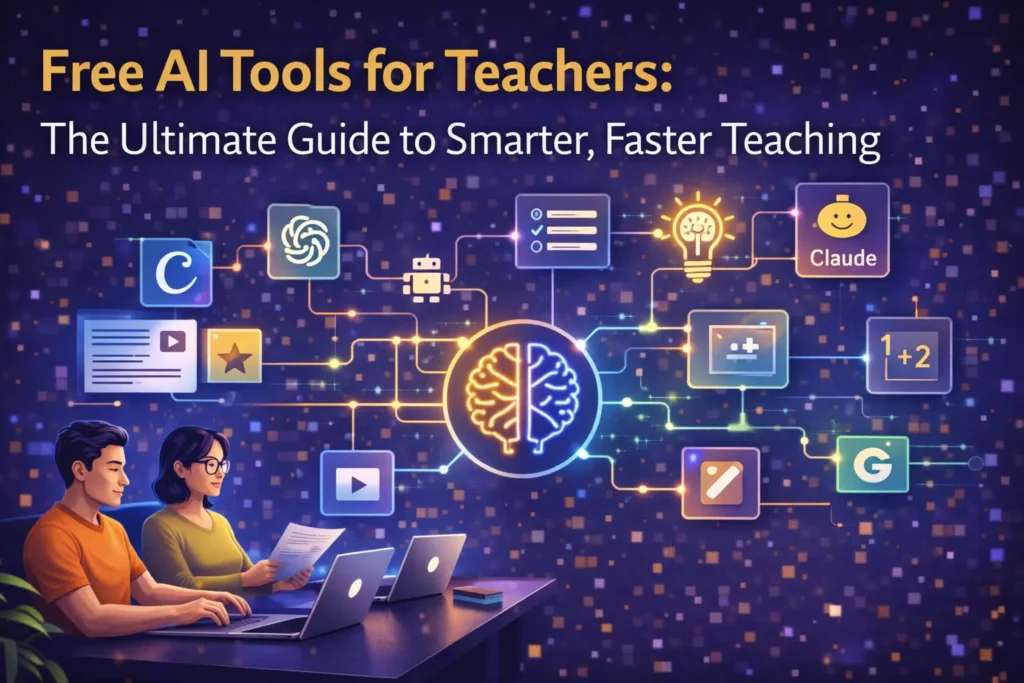
Do you teach and want to spend less time in an hour every week? You’re not alone. Educators around the world are now using artificial intelligence to handle lesson planning, grading, content creation, and student engagement — all without spending money.
Actually, Free AI Tools for Teachers have rapidly shifted past the realm of a nice-to-have and solidly established itself as a mandatory aspect of contemporary teaching. The current tools are more robust, less complicated, and classroom-specific.
This guide will help you:
- Discover the best free AI tools for teachers
- Understand how they actually help in daily teaching
- Learn how to use them effectively in your classroom
Why Teachers Are Turning to AI in 2026
Contemporary teaching is more demanding than ever. Lesson planning and grading, as well as administrative tasks and communication with parents make teachers work 50+ hours a week.
AI is not coming to take the place of the teachers, it is coming to aid the teachers.
According to a report by UNESCO, teachers who use AI tools save 5 to 10 hours per week on average. That’s a huge amount of time that can be used for:
- Better lesson delivery
- One-on-one student interaction
- Personal rest and work-life balance
Another important reason behind the rise of free AI tools for teachers is budget. Many schools have limited resources, and teachers often spend their own money. Free AI tools remove that barrier and make advanced technology accessible to everyone — including schools in underserved areas.
What Free AI Tools for Teachers Actually Do
- Save prep time: Lesson plans, worksheets, quizzes – No longer hours labored over, but made in minutes. You still go through and make adjustments to all of it, but you have the starting point.
- Make differentiation possible: You have 30 kids at 5 different reading levels. AI can adjust the same content for each level faster than you can say “individualized learning plan.”
- Handle the admin headaches: Progress reports, parent emails, rubrics, IEPs — AI drafts them so you just edit and send.
Why You Should Use More Than One AI Tool
Not all AI tools do the same job — and that’s a good thing.
Rather than using a single tool, it is always best to create a small toolkit depending on how you need it on a daily basis. For example:
- One tool for lesson planning
- One for grading
- One for student engagement
This way, you save more time and get better results.
Why Free AI Tools for Teachers Are Now Essential
In today’s fast-moving education system, free AI tools are no longer optional — they’re becoming necessary.
They help teachers:
- Save time
- Reduce repetitive tasks
- Create personalized learning experiences
- Improve classroom engagement
And the best part? Many of these tools are completely free.
Best Free AI Tools for Teachers by Category
Not every AI tool is used in the same way. The best approach that teachers can have is to develop a simple, narrow toolkit that will address their largest issues, be it lesson planning, grading, or student engagement.
This guide categorizes the best Free AI Tools for Teachers by category so that you can find the best tools to use in your classroom fast.
Lesson Planning and Curriculum Design
1. ChatGPT for Teachers — OpenAI’s Free, Educator-Specific Version
ChatGPT (Free Tier) One of the simplest tools that teachers can begin to use immediately is ChatGPT. It allows you to make lesson plans, discussion questions and classroom activities easily without having to take hours to make lesson plans. You may also utilize it to create rubrics or have new project ideas. It feels like having a teaching assistant who is always available.
- Create lesson plans quickly
- Generate questions and activities
- Get ideas for projects and rubrics
2. MagicSchool AI — The One Built Specifically for You
MagicSchool AI is built especially for teachers, so everything feels more relevant and practical. It helps with lesson planning, IEP suggestions, and creating assessments that match standards. You can also personalize learning materials for students. It saves time and makes teaching tasks feel much more manageable.
- 60+ tools for teaching needs
- Helps with IEPs and accommodations
- Creates standards-based content
3. Canva for Education — Design Like a Pro (Even If You’re Not One)
Canva Education allows one to design beautiful classroom materials without the need to have design skills. You are able to create slides, worksheets and posters within a few minutes. Magic Write is its AI, which helps you write, summarize text and plan lessons more quickly. It is ideal to visualize your teaching and make it more interesting.
- Design slides and worksheets easily
- Use AI to write and summarize
- Create engaging classroom visuals
- Grading and Feedback
4. Eduaide.AI — The Content Creation Machine
It is able to develop more than 100 kinds of instructional material lesson plans, assessments, discussion prompts, project-based learning problems, Socratic sequences of questioning, and bell ringers, exit tickets, etc. The free version is large enough to use on a daily basis.
What Makes It Special.
The variety of types of output is unrivalled. Unlike other tools which concentrate on lesson plans or quizzes, Eduaide addresses the entire instructional cycle – beginning with engagement hooks and progressing to formative assessment and reflection prompts. It also accommodates various languages, a huge score to bilingual education environments.
Best: Various teaching resources, standards-based content, pedagogically organized resources, and multilingual assistance.
5. Google Gemini — The Research Powerhouse That Connects to Everything
Google Gemini (previously called Bard), an AI, is now one of the most research-capable free AI tools that teachers can use. What sets it apart? It is part of the whole Google ecosystem of Search, YouTube, Maps, Scholar, etc. It does not simply come up with an answer to the question you pose it. Google Gemini also attracts real-time data and gives links to check it all.
To a teacher this translates to research supported, current responses that you can trust and refer to.
The way It is in Practice by teachers.
The science teacher who wants to teach a unit on climate change can request Gemini to supply her with the most up-to-date IPCC results, and it will provide her with actual information with references, not a generic paragraph that may be obsolete. It can be questioned by a social studies teacher to discuss two economic systems, and the result will be a structured answer with links to primary sources.
Ideal use: Research, current events, real-time fact-checking, and building personal AI assistants as well as the integration of Google Workspace.
Grading and Feedback
1. Brisk Teaching — The Chrome Extension That Lives
Brisk Teaching is based on such tools as Google Docs, which makes it highly convenient. It assists you in providing a clear and concise feedback on student work without wasting a lot of time. You can also adjust reading levels and create quizzes from online content. It fits naturally into your workflow.
- Give fast feedback on writing
- Adjust reading difficulty
- Turn articles into quizzes
2. Gradescope
Gradescope comes in quite handy when you have numerous assignments that you have to grade. It applies AI to cluster similar answers, and thus, you can rate more answers quicker and be consistent. This even reads handwritten responses, which is great for subjects like math and science. It reduces grading stress significantly.
- Speed up grading process
- Handle handwritten answers
- Great for STEM subjects
- Student Engagement and Interactive Learning
Student Engagement and Interactive Learning
1. Curipod
Curipod helps you turn any topic into an interactive lesson within seconds. It creates presentations with polls, questions, and fun activities that keep students involved. Students do not passively learn, they actively learn. It is an easy method of engaging your classroom without having to go out of your way.
- Create interactive lessons fast
- Add polls and activities
- Keep students engaged
2. Diffit — The Differentiation Tool You Didn’t Know You Needed
Diffit is perfect when you have students at different reading levels. You can paste any text, and it will adjust it to match your students’ abilities. It also creates questions to check understanding. This makes it easier to support every student without creating separate materials manually.
- Adjust content for any level
- Generate questions automatically
- Support all types of learners
- Communication and Administrative Tasks
Communication and Administrative Tasks
1. Goblin Tools
Goblin Tools works well in dealing with the daily teaching chores that may be daunting. It assists you in breaking down big tasks into small steps, composing e-mails fast, and being organized. It simplifies your work, no matter whether you are communicating with parents or arranging your schedule, making your work less stressful.
- Break tasks into simple steps
- Write emails easily
- Stay organized and productive
How to Start Using Free AI Tools for Teachers: A Step-by-Step Guide
Free AI tools to teachers do not necessarily need to be confusing to get started. It is always better to make things easy, and do things step by step. Rather than doing it all at once, concentrate on the things that do save your time and make your teaching better.
Step 1 — Determine Your Time-Waster.
You should know how your time is spent before using any tool. Take a few days observing your routine. Are you taking hours to plan lessons, grade or respond to mail? It is much easier to select the appropriate AI tool that can really positively impact your life after knowing what your greatest challenge is.
Step 2 — Begin With a single tool.
Trying out various tools is inviting to do, but this can easily cause confusion. Select only one of the tools depending on your primary issue. As an illustration, in the situation where planning the lesson is too long, begin with MagicSchool AI. In case grading seems too daunting, then use Brisk Teaching. Get it basic and expand on it.
Step 3 — How To Better Prompt.
AI is responsive to explicit instructions. Add details, instead of writing something basic. As an example, to develop a lesson plan, you could say:
Design an 8 th-grade science lesson about photosynthesis, including activities and a test.The more you input the better the results you end up having and that is why free AI tools to teachers are a lot more helpful.
Step 4 — Never Stop Reviewing and Personalizing.
AI can make an excellent first draft, but it is not familiar with your students. Read and revise again and again, adapting it to your classroom. Include your teaching style, examples and needs of students. This will be done to make sure that your teaching remains personal and effective.
Step 5 — Grow Gradually with Time. When you feel comfortable with one of the tools, then move to the next. Ultimately, you will be capable of developing a basic teacher-planning, teacher-grading and teacher-communication system using various free AI tools. This step-by-step method can make you remain stress-free and enhance your workflow.
Addressing Common Concerns About AI in Education
Is It Ethical for Teachers to Use AI?
Yes, the application of AI in teaching is perfectly okay when it is applied properly. Just imagine that you are using a calculator or Google it is a simple tool that will help you in your work. The trick lies in having AI as an aid, not as a substitute to your thought. Your teaching experience with AI can even be better in most cases.
Will AI Replace Teachers?
No, teachers will not be replaced by AI. It is not only about the subject matter when teaching but also about relationships, comprehension, and mentoring. AI is unable to form relationships, encourage students, and comprehend feelings. It can do what it can do and that is, cut down your workload so that you can give more attention to your students
Are Free Tools Safe and Private?
Free AI tools that may be used by teachers should be considered in terms of safety and privacy. When using the tool, always ensure that you have read its privacy policy. Education data protection regulations apply to such trusted platforms as Canva for Education and MagicSchool AI. Do not provide the names of students or other personal information unless you are certain that the site is not susceptible to attacks.
Conclusion
Teaching has never been easy. Still, the nature of hard that it is now, the emails, the paperwork, the differentiated lesson plans that you have to make that accommodate thirty-five different learners, the grading that drags you home every night of the week, that aspect does not necessarily have to remain the same.
Teacher-friendly free AI tools are altering the everyday reality of education not in the distant future, but now. In a 2025 survey of more than 2,200 teachers in U.S. public schools, it was estimated that 60% of teachers at the school used AI throughout the school year, and the teachers who used it weekly saved about six hours of work each week. That translates to about six weeks of time saved during a complete school year. Six weeks. Imagine what you would do with six weeks – more individual meetings with struggling students, more creative work, more time to breathe and actually enjoy the job you decided to do.
And here what distinguishes this moment among all the tech revolutions that have claimed to revolutionize education and failed: these are free, easy, and accessible, and they integrate into platforms already accessible to teachers. You don’t need a technology degree. You don’t need your district to approve a budget.
That said, nobody should pretend AI is perfect. Only 6% of K-12 teachers believe AI tools do more good than harm — and that caution is healthy. AI can produce biased results. It can get facts wrong. It doesn’t know your students the way you do, and it never will. The point was never to hand your classroom over to a chatbot. The point is to let the machine handle the parts of your job that drain you so you can focus on the parts that matter.
If you’re a teacher reading this and you haven’t tried a single AI tool yet, you’re not behind. Forty percent of teachers still haven’t used AI at all, and 68% reported receiving zero training on it from their schools. The system hasn’t caught up. But you don’t have to wait for the system. Pick one tool from this guide — just one. Give it fifteen minutes. See if it helps. If it doesn’t, try another. If it does, you just got a little bit of your time back.
Frequently Asked Questions
What are the best free AI tools for teachers in 2026?
The top free AI tools for teachers include MagicSchool AI for lesson planning and IEP support, ChatGPT’s free tier for general content creation, Brisk Teaching for grading and feedback, Curipod for interactive lessons, and Diffit for differentiated reading materials. Each addresses a different aspect of teaching and works well as part of a combined toolkit.
Can teachers use ChatGPT for free?
Yes. ChatGPT has a free edition that includes its GPT-4o-mini model. The version is robust enough to write lesson plans, write assessments, write discussion questions and help with most educational tasks without cost.
Are AI tools safe to use in schools?
The vast majority of the trusted AI education resources are in line with FERPA and COPPA. Nevertheless, educators must make sure that the privacy policy of a platform is reviewed prior to use and that they do not input any personally identifiable student data into any AI system without the consent of the district.
How can AI help teachers save time?
AI will save time and replace manual processes like lesson plans, quiz creation, grading written assignments, reading-level adjustments, writing parent emails, and rubric creation. Teachers who employ such tools all testify to saving between 5 and 10 hours weekly.
Do I need technical skills to use AI teaching tools?
No. The recommended free AI tools in this guide are user-friendly. Most only need to type out a request by plain language and look at the output. You can make use of these tools once you are able to write an email.