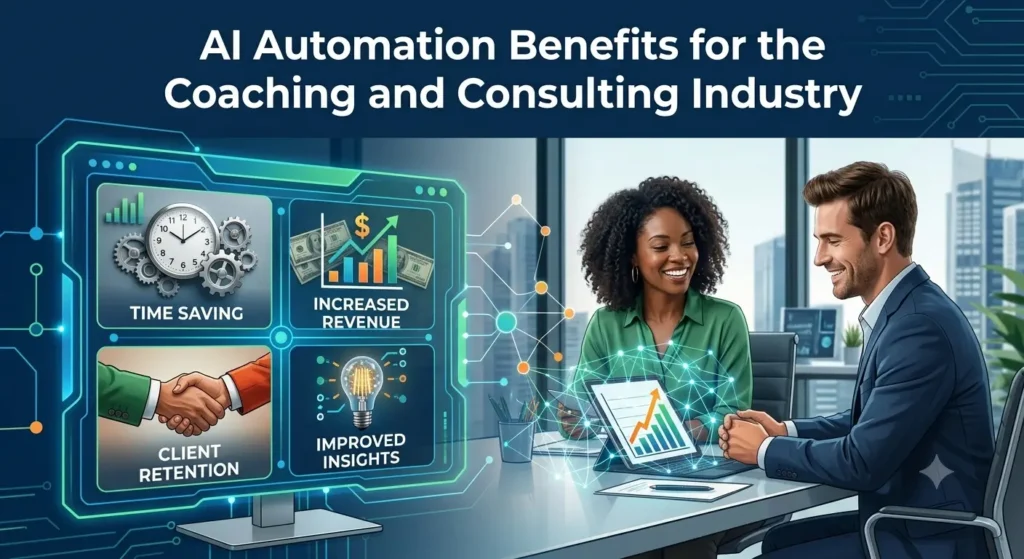
Whether you are a coach or consultant, you probably spend a significant portion of your day on simple paperwork. Follow-ups, appointments, onboarding new clients, preparing content, tracking progress and preparing reports are essential. However, these occupations can take a lot of time.
There are many of these repetitive tasks that AI automation can assist you with. It lets you invest more time in your clients, build strong relationship with them, have strategies and let people achieve real results. It can also help to grow your business without adding to your current workload.
The important point to take away from this is that AI automation for coaching and consulting isn’t a replacement for human beings. Rather, AI can provide all the heavy lifting of the routine tasks, leaving more time for coaches and consultants to get to know people, share their experience, build a relationship and get their clients to succeed.
Why AI Automation Matters for Coaches and Consultants
Coaching and consulting are relationship-driven services. However, running these businesses involves many tasks that do not require direct human expertise.
Professionals spend time entering CRM data, answering routine questions, creating meeting notes, sending reminders, preparing reports, qualifying leads, and following up with prospects. AI-powered workflow automation can handle much of this operational workload.
The opportunity is significant. The International Coaching Federation’s 2025 Global Coaching Study reported a record 122,974 coach practitioners worldwide—a 15% increase since 2023. The profession generated an estimated $5.34 billion, while 59% of coaches expected their revenue to grow.
AI adoption is also accelerating globally. According to the OECD, 20.2% of firms used AI in 2025, compared with 8.7% in 2023. Adoption reached 36.8% among professional and scientific services firms.
These numbers show that AI-enabled delivery is becoming a competitive capability rather than an optional experiment.
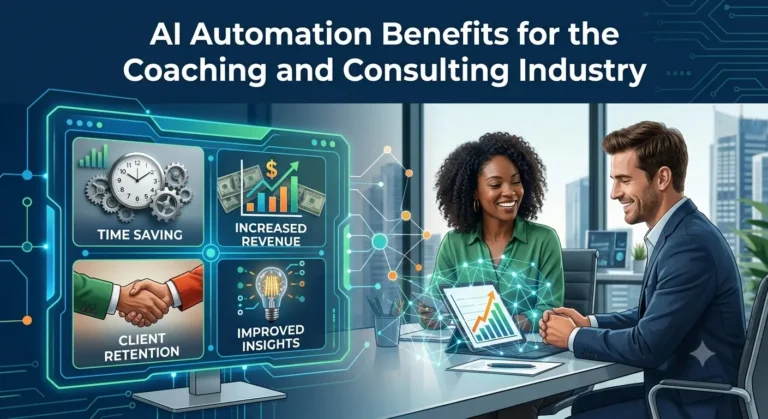
What Are the Main AI Automation Benefits?
1. More Time for High-Value Client Work
The greatest advantage is the time saved. Discovery calls can be summarized, notes can be organized, action lists can be generated, follow-up emails can be drafted, and client records can be updated via AI.
The study by the Federal Reserve Bank of St. Louis revealed that generative AI users saved an average of 5.4% of their working hours. That’s about 2.2 hours a week for a 40 hour-a-week worker.
This saved time would allow a business coach to review their client’s strategy. A consultant might use it to work through an intricate problem rather than designing a presentation.
2. Faster Lead Generation and Follow-Up
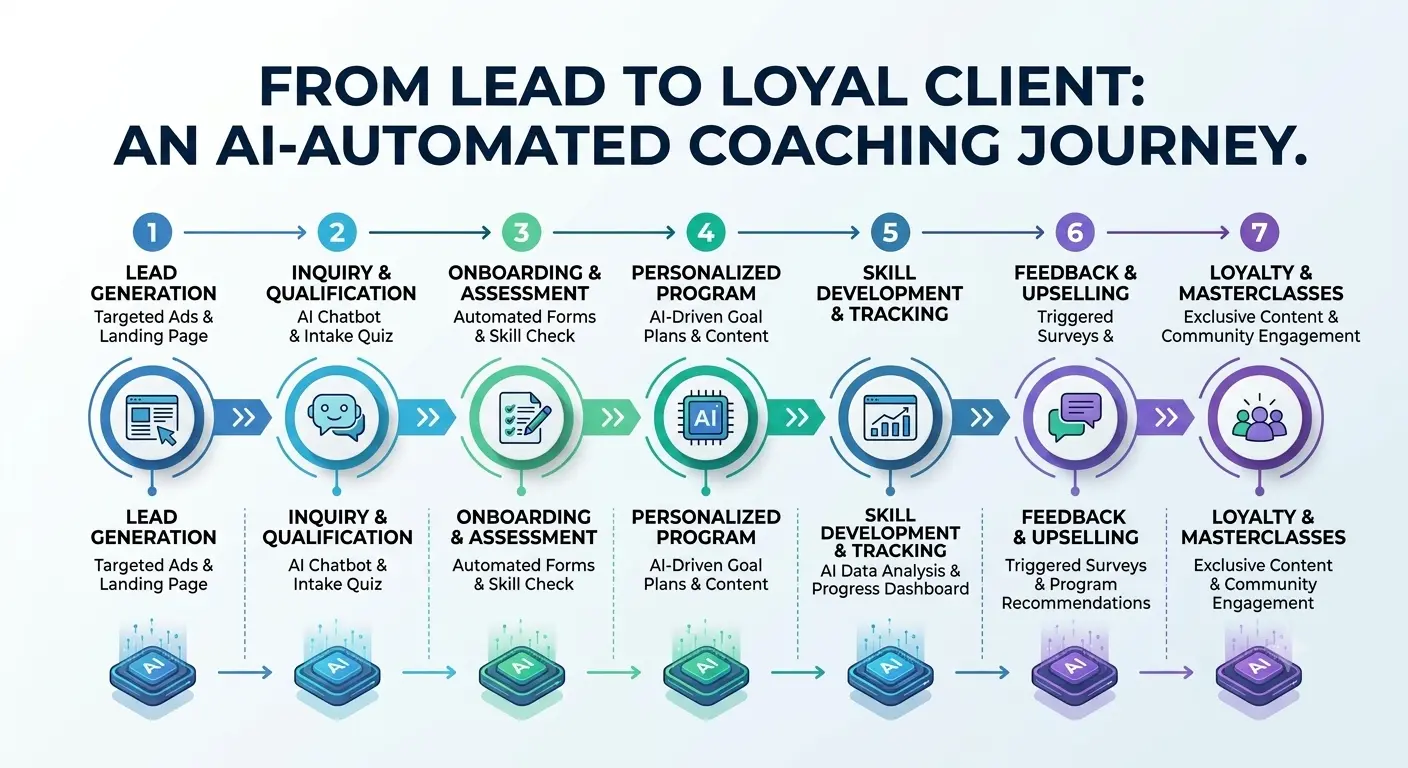
A potential customer could browse the website or download a guide or even send a query after hours.A prospective customer can view the website, read a guide or even submit a contact request at any time of the day just after business hours. With AI, automation can engage in a timely response, engage in qualifying questions, recommend a relevant service, and book a call with the prospect.
It can also split up leads based on the objectives, business size, spending budget, or urgency of the lead. The coach or consultant has more information prior to the first conversation.
This helps to eliminate missed opportunities and leave the personal sales dialog for qualified prospects.
3. A Smoother Client Onboarding Experience
Manual onboarding can lead to delays. Contracts, questionnaires, payment links, meeting invites, and program materials may be waited for by the client.
An automated onboarding process can:
- Use a welcome email that is personalized.
- Collect agreements and payments.
- Share intake forms.
- Establish a client folder or portal.
- Make an initial appointment.
- Deliver preparation materials.
- Let the coach know when onboarding is finished.
The outcome is an uninterrupted and professional process ever since a client says yes.
4. Personalized Client Support at Scale
Approved client information, including goals, assessment answers, summary of sessions, and completed actions, can be analyzed by AI. It can then be used to help create a tailor-made exercise, reflection questions, learning material or progress report.
For instance, an executive coach may develop various follow-up resources for a new manager and a senior director. A marketing consultant might be able to create individual performance reports for each of the client’s business areas, such as retail, healthcare, or professional.
Personalization always should be checked by a qualified professional. AI can suggest or write, but it is the responsibility of the coach or consultant to provide context and quality.
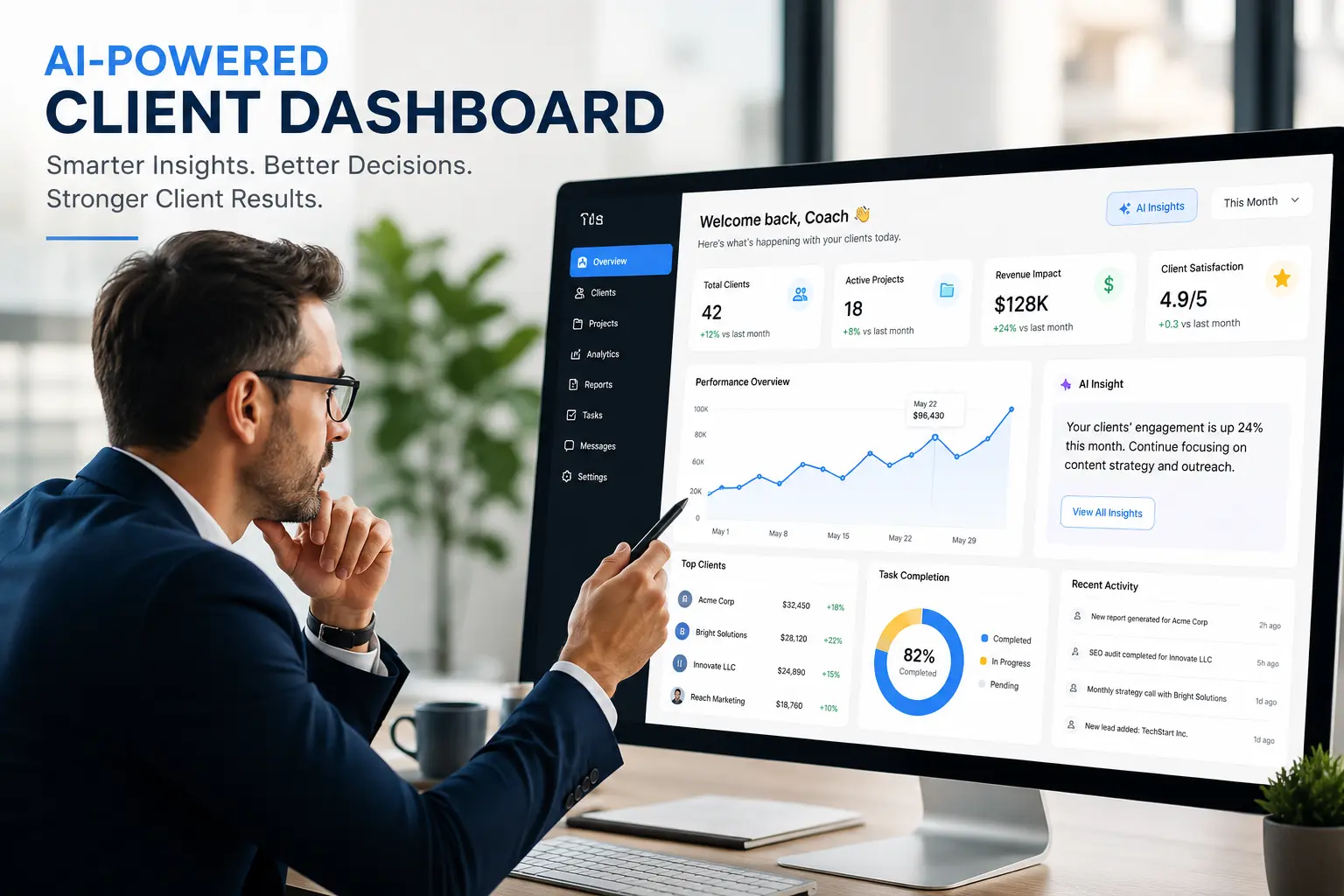
5. Better Decisions Through Client Data
Analytical tools can provide insights that are hard to find without human effort. A firm can learn which services have the greatest retention rate, which sources of leads are bringing in good clients, or where clients are likely to drop out of assignments.
Some of the useful performance indicators are:
- Consultation-to-client conversion rate
- Client acquisition cost
- Session attendance
- Program completion
- Goal achievement
- Client satisfaction
- The percentage of people who renew and who are referred.
- Revenue per client
These learnings allow business owners to fine-tune pricing, service design, marketing and resource planning.
6. Consistent Content and Knowledge Management
Coaches and consultants will typically produce newsletters, reports, proposals, social media posts, workshops and thought-leadership articles. AI can turn an approved webinar transcript into several draft assets or organize internal frameworks into a searchable knowledge base.
But this does not take the place of subject-matter expertise. Most AI-generated content is generic.Most AI content is not authoritative. The best solution is a mix of AI efficiency and original experience, client feedback, case studies, and expert comments.
7. Scalable Growth Without Proportional Costs
Traditional growth usually requires more administrative staff. Automation allows a practice to serve additional clients without increasing overhead at the same rate.
McKinsey estimates that generative AI could add $2.6 trillion to $4.4 trillion in annual global economic value. It also identifies customer operations and marketing and sales as two of the four areas representing about 75% of potential value.
These are especially relevant functions for independent coaches and boutique consultancies.
Will AI Replace Coaches and Consultants?
AI is more likely to transform these roles than eliminate them. It can process information and automate predictable tasks, but clients still need trust, accountability, emotional intelligence, ethical judgment, and advice based on real-world experience.
The best model is human-led, AI-supported service. AI manages speed and scale; the professional provides judgment, empathy, creativity, and responsibility.
Conclusion
The most valuable AI automation benefits for coaching and consulting businesses include improved productivity, faster response times, better personalization, consistent service delivery, and scalable growth.
Success does not come from adopting the largest number of tools. It comes from automating the right processes, protecting client trust, measuring outcomes, and preserving human oversight. Start with one repetitive workflow, prove its value, and expand responsibly. Used this way, AI becomes a reliable business assistant—not a replacement for expertise.
Frequently Asked Questions
1. What is AI automation in coaching and consulting?
AI automation uses artificial intelligence and connected software to complete routine tasks such as scheduling, lead qualification, meeting summaries, onboarding, content drafting, and client reporting.
2. How does AI benefit a coaching business?
AI reduces administrative work, improves lead follow-up, personalizes client communication, organizes session information, and helps a coach serve more clients without reducing service quality.
3. Which coaching tasks should not be fully automated?
Sensitive conversations, psychological assessments, strategic recommendations, conflict management, ethical decisions, and high-impact client advice should remain under qualified human supervision.
4. Is AI automation expensive for small consulting firms?
Not necessarily. Small firms can begin with existing scheduling, CRM, email, transcription, and workflow tools. Start with one high-volume process and compare the subscription cost with the time or revenue gained.
5. How can consultants measure AI automation ROI?
Measure hours saved, reduction in errors, faster delivery, lead conversion, client retention, satisfaction, automation costs, and additional revenue. Compare these results with a baseline recorded before implementation.
Sources:
- ICF Global Coaching Study
- Coaching Industry Continues Global Growth with $5.34 Billion USD Revenue, New Research Reveals
Disclaimer: The information provided in this article is for educational purposes only.